🇦🇷 Argentina Digital Nomad Guide: Your Dream Life in Buenos Aires and Beyond
Buenos Aires is no longer a bargain, but it’s still one of the great cities to live and work in. Dreaming of making it yours? Here’s what you need to know about costs, internet, safety, the nomad visa and taxes right now.
At a glance
| Monthly budget | €1,500-2,400 in Buenos Aires; €1,000-1,700 in Mendoza or Córdoba |
|---|---|
| Internet | Fiber 100-500 Mbps for 25,000-50,000 pesos (about €17-35) a month |
| Time zone | UTC-3, no daylight saving time |
| Best season (Buenos Aires) | October-December and March-May |
| Longer stays | Digital nomad visa, 180 days, renewable once for 180 days |
| Tax on foreign income | None as a non-resident; residents taxed on worldwide income up to 35% |
| Healthcare | Good private care; local prepagas open to foreigners |
Argentina for digital nomads: what changed in 2025
Dreaming of Argentina as your next nomad destination? Don’t let outdated advice shape your adventure. For years Argentina had two exchange rates, and foreigners who changed cash at the unofficial "blue dollar" rate enjoyed 50-100% more purchasing power. Most guides from 2019 to 2024 were built on that. But that’s no longer the reality.
In April 2025 the government largely lifted currency controls as part of an agreement with the International Monetary Fund. The peso now moves within a band, the gap between the rates has shrunk to a few percent, and foreign cards settle at the market rate. With inflation pushing prices up, Buenos Aires is no longer a bargain; it’s priced like any other big city. Plan for the reality, not the old promise.
But the reasons to fall in love? They’re still here: one of the most beautiful and culturally rich cities in the world, outstanding beef and wine, and a time zone that works well with Europe.
Everyday life in Buenos Aires
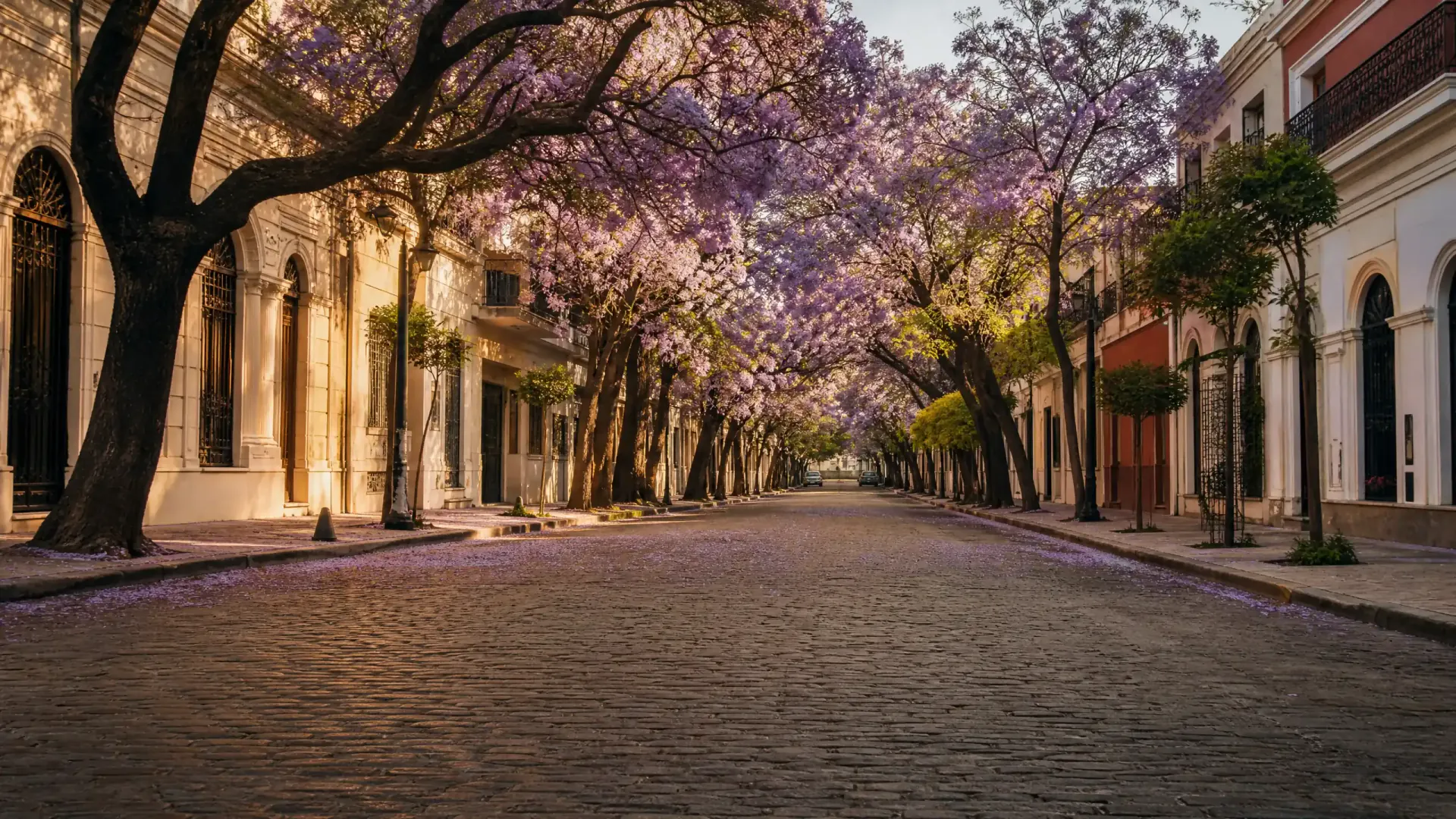
Lose your heart to Buenos Aires: a city with a European soul in the heart of South America. Imagine Haussmann-style facades, cafés with marble tables, bookshops, theaters and a world-class opera house. It’s a city that draws you in, where much of the population has Italian or Spanish roots.
Here, your nights come alive. Dinner starts at 9 or 10 pm, and going out starts around midnight, even on weekdays. Love café culture? You’ll feel right at home. Settle in, open your laptop and work for hours without anyone minding, with good cafés offering sockets and Wi-Fi everywhere.
But falling in love doesn’t erase the frustrations. Bureaucracy can wear you down: opening a bank account routinely takes months and several appointments, while the DNI, the national ID number, takes months to process.
Where to base yourself
Buenos Aires is where your adventure begins, your first choice, your pulse-racing introduction. Everywhere else adds another layer to fall in love with.
- Palermo, with Soho, Hollywood and Botánico, makes falling in love effortless: leafy streets, restaurants, cafés and coworking, all with the most international feel.
- Recoleta lets you exhale: elegant, established surroundings and the quieter escape you crave.
- San Telmo steals your heart: old, rough around the edges and overflowing with character.
- Villa Crespo and Chacarita give your budget breathing room: cheaper and less international.
- Belgrano invites you to slow down: green, residential and refreshingly spacious.
Mendoza, at the foot of the Andes, is the wine-country escape you dream about: sunny, dry and much calmer, the best base for mountains, wine and outdoor life. Córdoba, the second-largest city, pulses with youthful university energy and costs much less than Buenos Aires. Bariloche and the Patagonian lakes promise scenery that takes your breath away, but are expensive and thin on infrastructure. Salta, in the northwest, is your cheap, distinctive escape, a world away, far from everything.
Internet and coworking
Feel connected in Buenos Aires, where good connectivity keeps your day moving. Fiber with 100-500 Mbps costs 25,000-50,000 pesos a month, roughly €17-35. Mobile data works, but Argentina is not a leader in Latin America. Heading beyond the big cities? Coverage gets thinner, and in parts of Patagonia it is seriously poor.
Find your focus in Buenos Aires, with plenty of good coworking spaces and fixed desks at 150,000-350,000 pesos a month. Prefer a café? They’re a real alternative. And when you’re ready to build your network, the strong local tech scene, with good English, helps you make those connections.
Food and wine
The architecture captures your heart. The food makes leaving feel impossible. Argentine beef is outstanding, and asado, the barbecue, isn’t just a meal, it’s a cherished social institution. Settle in for a parrilla feast with good meat and a bottle of Malbec, and savour the moment: you’ll pay much less than you would for the equivalent in Europe.
The Italian influence is deliciously irresistible: pasta, gelato, and medialunas with dulce de leche. Mendoza brings you world-class Malbec, plus Cabernet Franc, Bonarda and high-altitude whites, and the sheer joy of discovering a very good bottle for a fraction of the European price. Craving something more intimate? Seek out puertas cerradas, private restaurants run in apartments.
What might you find yourself longing for? Spice, a wide range of Asian food, and vegetables taking a starring role.
People and community
Feel the warmth from your very first conversation. Argentines are talkative, warm, ironic and deeply sociable. People are direct and personal, and friendships can spark before you know it.
You need Spanish, but it’s your doorway into everyday life. English is more common among younger, educated city dwellers and in tech than in many neighboring countries, but daily life runs in Spanish, with its distinctive Argentine sound and the voseo form of address.
Find your people in Palermo’s mid-sized, strongly North American nomad scene. And a fascinating cultural detail: Buenos Aires probably has the highest density of therapists in the world.
The Argentina digital nomad budget after the peso reforms
Dreaming of Argentina? Know what your budget really buys. After a drastic devaluation in December 2023 and the end of most currency controls in April 2025, prices have caught up. Inflation fell from over 200% in 2023 to 31.5% in 2025, with around 25-30% expected for 2026. Plan your move with confidence: the euro figures below are a mid-2026 snapshot.
| Item (per month) | Buenos Aires | Mendoza / Córdoba |
|---|---|---|
| Furnished studio, Palermo/Recoleta | €700-1,100 | €400-700 |
| One-bedroom apartment | €900-1,500 | €550-900 |
| Groceries and eating out | €450-800 | €380-650 |
| Coworking, fixed desk | €100-240 | €80-160 |
| Fiber internet | €17-35 | €17-35 |
| Getting around | €40-90 | €40-90 |
| Private health insurance | €80-200 | €80-200 |
Fall in love with the city, not the promise of rock-bottom prices. Realistically, you spend €1,500-2,400 a month in Buenos Aires and €1,000-1,700 in Mendoza or Córdoba. That puts Buenos Aires roughly on a level with Lisbon or Madrid. Come for the city, not for the prices.
Make your money work for your adventure. Pay with a foreign card, always choose to be charged in pesos and decline the currency conversion offered at the terminal. Do not hold reserves in pesos. A local bank account is hard to get, and, as a nomad, you rarely need one. Find setups that work on the road in banking for digital nomads.
Safety and health
Feel more confident about your next chapter: by Latin American standards Argentina is safe, much safer than Brazil, Colombia or Mexico. Buenos Aires calls for the usual big-city awareness. The main concerns are pickpocketing and phone theft, especially downtown, in La Boca and on public transport. Reassuringly, violent crime against foreigners is rare.
A few simple habits help you explore with greater peace of mind: keep your phone out of sight on the street, avoid walking through certain areas at night, stay on the tourist street in La Boca, and use Uber or Cabify after dark. Prefer a more relaxed pace? Mendoza, Córdoba and the provincial cities offer just that.
Your health matters, and healthcare is a strong point. Private care in Buenos Aires offers well trained doctors, modern equipment and short waits. Private health plans, the prepagas, welcome foreigners and are cheap by international standards. The public system is free but underfunded. For this next chapter, you need either an international policy or a local prepaga.
Climate
From the subtropics almost to Antarctica, Argentina stretches 3,700 km, putting every climate within reach. Find the one that feels like you.
- Buenos Aires offers a temperate climate, with seasons reversed from the northern hemisphere. Escape to hot, humid summer days (December-February), often over 30°C. Winter (June-August) is mild to cool at 8-15°C, but damp and uncomfortable in poorly heated old apartments. For the best experience, choose October-December and March-May.
- Mendoza delivers dry, sunny days, hot summers and cold nights.
- Patagonia beckons from December to February, when it’s accessible; otherwise, it’s windy, cold and partly closed.
- Salta and the northwest offer mild, dry weather all year.
Getting there and time zone
Your Buenos Aires adventure is closer than you think: from Europe, fly direct from Madrid and Frankfurt, or connect via Madrid, Paris, Amsterdam, São Paulo or Istanbul. Once you’re in Argentina, the sheer distances make flying almost the only practical option. Prefer the road? The long-distance bus network is good, but slow.
Stay connected to Europe while making Argentina your home. Argentina runs on UTC-3 all year, with no daylight saving time: four hours behind central Europe in the northern winter and five in the northern summer. A 2 pm call in central Europe is 9 or 10 am for you; your whole morning overlaps with the European working day, the same setup as Brazil.
The real trade-off? Distance, not the clock: a quick trip home is not an option.
Entry and the digital nomad visa
Your Argentina adventure is calling, but before you fall in love with the possibilities, check how long your passport lets you stay as a visitor. Confirm the current rules for your nationality before you plan.
Not ready to let the dream end with a short visit? The digital nomad visa, introduced in 2022 by Disposición 758/2022 as a temporary residence under Article 24(h) of Migration Law 25.871, could be your next chapter. Here’s what matters:
- Give yourself time to truly live it: it runs for 180 days and can be renewed once for another 180 days, so up to one year in total.
- Bring your dream closer to reality: prove foreign-source income and remote work, and have health insurance and criminal record certificates ready.
- Don’t let one missed detail put your plans at risk: criminal records are required for every country where you lived for more than a year in the last three years, not just your current country. Many applicants already abroad miss this.
- Save yourself the last-minute stress: all foreign documents need an apostille and a translation by a public translator registered in Argentina. Each takes one to three weeks, and appointments in the RaDEX online system often fall through when applicants plan both in the same week.
- Protect the freedom you’re chasing: the visa allows remote work for foreign clients, not local employment.
Your future deserves more than guesswork: residence and citizenship rules have been in flux since 2025. Decree 366/2025 mainly tightened naturalization; in late June 2026 the National Electoral Chamber declared it null, and the government has appealed to the Supreme Court. Since late July 2026, Decree 681/2026 has added grounds for expulsion and entry refusal. Check the current state before any step toward permanent residence.
Build your dream on something stronger than border runs. Ferry trips to Uruguay to restart a visa-free period are largely tolerated, but they are not a long-term strategy or a legal basis for work. Ready to turn “one day” into a plan? Our Argentina digital nomad visa page walks you through the application step by step.
Taxes in Argentina
Your freedom matters, and so does the income you work hard to earn. Argentina taxes residents on their worldwide income at progressive rates of up to 35%. Non-residents pay tax only on Argentine-source income.
Here’s the crucial distinction: tax residence does not follow the usual 183-day rule. As a foreigner, you become resident when you obtain permanent residence or after 12 months in the country, with worldwide taxation from the 13th month. Absences of up to 90 days do not interrupt the count; a longer continuous absence resets it. The reassuring part? If you use the nomad visa as a temporary residence and keep to its periods, you normally do not become tax resident, so income from foreign clients stays out of Argentine tax.
Before you commit, know these two points:
- Monotributo, the flat regime for small businesses, requires an Argentine tax ID and a residence status. Don’t mistake it for a nomad shortcut: its turnover limits change twice a year (in August 2026 roughly 12 million to 127 million pesos), and it is not meant for non-resident nomads with foreign clients.
- Bienes Personales, the annual wealth tax, puts residents’ worldwide assets in scope. The allowance for tax year 2025 is about 385 million pesos (around €220,000), with an extra allowance for your main home, and rates are 0.5-1.0%. The law plans a single 0.25% rate from tax year 2027. If you hold significant assets, this remains a powerful reason to think twice about Argentine residence.
Don’t leave your next chapter to guesswork. Get the full picture in this Argentina tax guide.
Your tax situation at home
You’ve left the country, but have your tax obligations followed you? Leaving does not automatically end your tax residence. Whether you remain taxable at home depends on your home country's rules, including where you keep a home, where your family lives and how many days you spend there. A winter in Buenos Aires changes nothing if everything at home stays the same. Don’t leave this to chance: also check whether your home country has a tax treaty with Argentina.
US citizens, don’t overlook this: you remain subject to US income tax on your worldwide income wherever you live (IRS: US citizens and resident aliens abroad).
Stop guessing about how it all connects. Our guide on where digital nomads pay taxes explains how home country, host country and tax treaties fit together.
Is Argentina right for you?
Imagine a big, culturally rich city that feels European, yet takes you somewhere entirely different. If incredible food, wine and conversation feed your soul, you’re learning Spanish, and a four to five hour gap to Europe fits your life, Argentina could be your place.
But don’t let the romance overshadow reality: Argentina is a weaker fit if you’re chasing low prices, need to get home quickly, dread paperwork, or hold significant assets and want a new tax residence.
Craving the same time zone, a warmer climate and similar prices? Explore Brazil. If stability and safety matter more to you than energy, look across the river to Uruguay, a far more attractive choice for tax residence.
Frequently asked questions
Is Argentina still cheap for digital nomads?
Not anymore, and that dream budget could disappear fast. Since currency controls were largely lifted in April 2025, the blue dollar advantage is gone and foreign cards settle at the market rate. Expect to spend €1,500-2,400 a month in Buenos Aires and €1,000-1,700 in Mendoza or Córdoba.
Do digital nomads pay tax in Argentina?
Your Argentina adventure shouldn’t come with tax uncertainty. Non-residents pay tax only on Argentine-source income. As a foreigner, you become tax resident with permanent residence or after 12 months in the country. Stay within the periods of your 180 plus 180 day nomad visa, and you normally stay non-resident.
How does the Argentina digital nomad visa work?
Make Argentina your next chapter. Introduced in 2022, this temporary residence gives you 180 days, renewable once for 180 days. Ready to make it happen? You need proof of foreign income and remote work, health insurance, and criminal records from every country where you lived more than a year in the last three years, all apostilled and translated.
Can I work for clients in Europe or North America from Argentina?
Yes, bring your clients with you, and make Argentina your next chapter. Argentina is on UTC-3 with no daylight saving time, four to five hours behind central Europe, so your morning overlaps with the European working day. The nomad visa covers remote work for foreign clients, not local employment.
Thinking about Buenos Aires?
Fall for Argentina. Keep your stay a stay.
Your time in Argentina should feel exciting, not uncertain. In a consultation, we explore how your stay fits your life, how to keep it below the residence threshold, and where your tax residence should sit instead.
Book a consultation