🇵🇦 Panama for Digital Nomads: Unlock Your Freedom with Territorial Tax and Flexible Residence
Your earnings from outside Panama? Panama does not tax them. It uses the US dollar and offers residence routes with no minimum stay, freedom on your terms. The trade-off? Tropical heat, high prices for Latin America and a capital built for business, not beauty.
At a glance
| Monthly costs | Panama City €1,800-2,800; Boquete €1,400-2,100 |
|---|---|
| Internet | Fiber 100-500 Mbps for US$35-70 a month in Panama City |
| Time zone | UTC-5 all year, no daylight saving time |
| Best season | Dry season, mid-December to April |
| Digital nomad visa | US$3,000 a month from foreign sources; 9 months, renewable once (max 18 months) |
| Residence routes | Friendly Nations (2 years provisional, then permanent), Qualified Investor (US$300,000 new or US$500,000 resale property), Pensionado (US$1,000 pension) |
| Tax on foreign income | None: Panama taxes only Panamanian-source income |
Why Panama works for digital nomads
Imagine the relief of keeping more of what you earn, without a remittance catch hanging over you. Panama makes the clearest tax statement of any country we cover: what you earn outside Panama is not taxed in Panama, whether or not you bring the money into the country.
No remittance condition. No requirement for the income to have been taxed at source. No rule that makes you tax resident simply because you hold a permit. Just the clarity you need to plan your future with confidence.
The US dollar is legal tender, removing currency risk. The residence programs generally require no minimum stay; just do not stay away for more than two consecutive years. Enjoy the freedom to move, with Panama City as one of the best-connected hubs between North America, South America and Europe.
The trade-offs? A time zone far from Europe, heat and humidity all year, and a capital that is functional rather than beautiful. Go in knowing the reality, and decide whether this freedom is right for you.
Everyday life
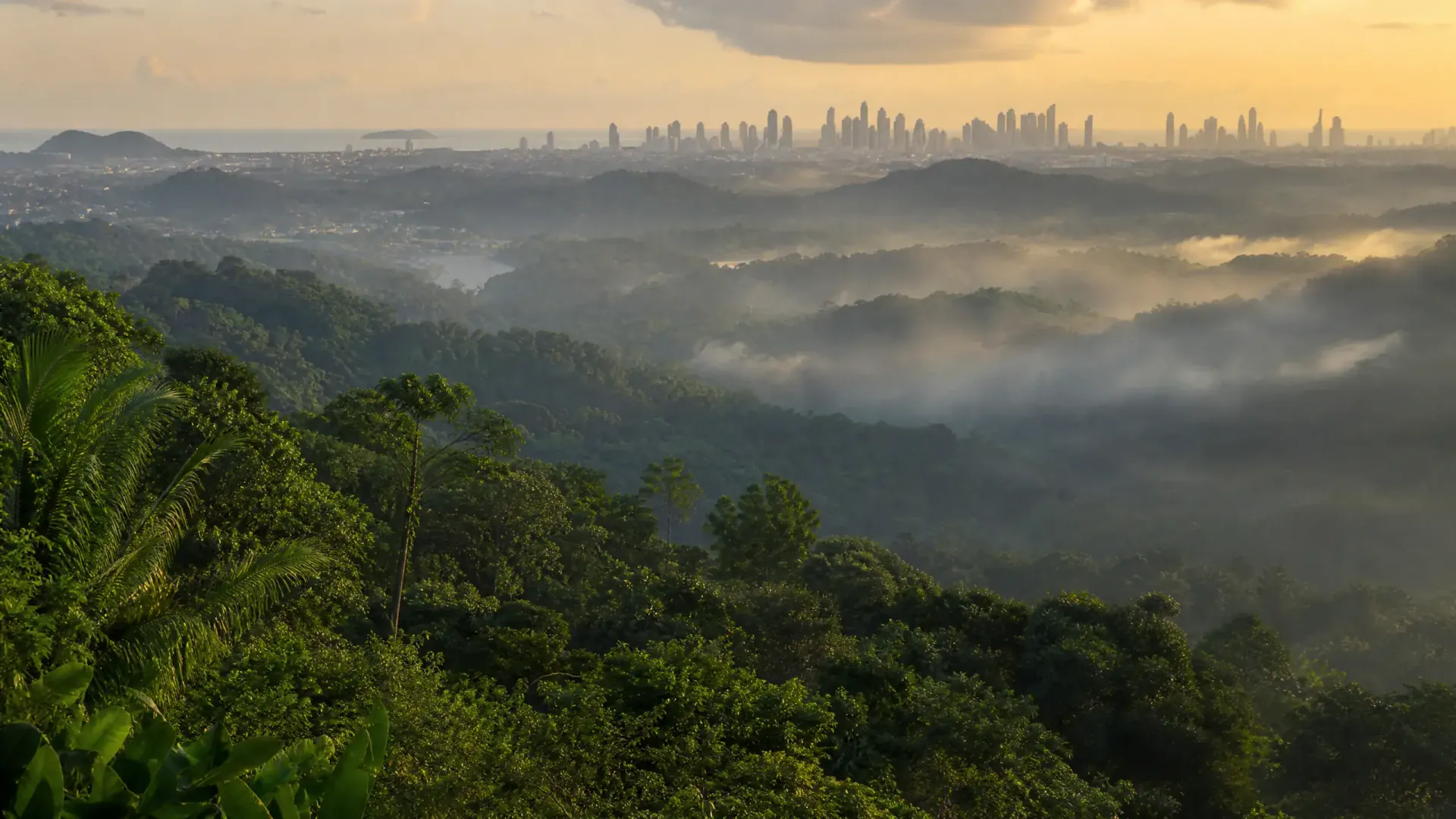
Picture your everyday life in Panama City: soaring skyscrapers above a bay, a thriving financial center surrounded by rainforest. Within an hour, you can leave your office tower behind for a national park, with sloths in the trees. Not just a different view, a whole different feeling.
Starting fresh feels less daunting when you don’t feel like an exception. As a finance and logistics hub, Panama has infrastructure for foreigners: lawyers, accountants, banks, international schools and US-trained doctors. You’re not a special case here. You’re someone this city is already equipped to welcome.
The reality check? Traffic in Panama City, the heat, and a bureaucracy that works but assumes you have a lawyer can wear you down. Practically every residence procedure must go through a licensed Panamanian lawyer. Know that upfront, plan accordingly, and take your next step with your eyes open.
Where to live: find your place
Panama City is the obvious choice when infrastructure is a must. Fall for Casco Viejo, the pretty, restored old town: touristy, lively and home to the best restaurants and bars. San Francisco and Bella Vista put you in central residential areas. Costa del Este is new, planned and family-friendly, but sterile. Want somewhere cheaper? El Cangrejo is denser and older.
Boquete in the Chiriquí highlands is the most interesting alternative, and a breath of fresh air. At about 1,200 meters, it is much cooler and green, surrounded by coffee farms and home to a large, established foreign community. Tired of lowland heat? Boquete is your answer.
Bocas del Toro on the Caribbean coast is your island escape: houses on stilts, surfing and a small international scene. Just know the trade-off: much weaker infrastructure and unreliable internet.
Coronado and the Pacific beaches west of the capital draw retirees; craving somewhere quieter? Pedasí on the Azuero peninsula offers that slower pace, though it is still developing.
Internet and coworking
Stay connected with confidence in Panama City. Fiber with 100-500 Mbps costs US$35-70 a month. It’s expensive for Latin America, but you get solid quality, and Panama’s role as a submarine cable hub means good international connections. In the cities, solid mobile coverage keeps you connected on the move.
Beyond the cities, be ready for compromises: connections get unreliable, especially in Bocas del Toro and rural areas, and power cuts happen. Boquete is usable, but don’t expect capital-level connectivity.
Find your workday rhythm in Panama City, with a decent choice of coworking spaces at US$150-350 a month for a fixed desk. Prefer Boquete? You’ll find a few there, too.
Food and coffee
Food is one of Panama's weak points, but simple pleasures still have their place. Think rice, beans, chicken, plantains and sancocho, the national dish. Panamanian cooking is good and cheap, just not the reason you’ll fall in love with the country.
Where Panama City truly comes alive is its extraordinary international variety, shaped by more than a century of migration: Chinese, Lebanese, Colombian, Venezuelan, Italian and Japanese food, some of it very good. Add Casco Viejo’s serious restaurant scene, and there’s plenty to get excited about.
Then there’s the coffee. Grown in the Boquete highlands, it’s among the best in the world, especially the Geisha variety, which sets record prices at international auctions. This is coffee worth getting excited about.
People and community
Breathe out. Feel at home with Panamanians: friendly, easygoing and calm. Everyday dealings are less effusive than in Colombia and less formal than in Uruguay, striking a welcome balance, perfect if you’re longing to relax and simply be yourself.
Spanish is the everyday language, but English is far more common than in most of Latin America, especially in Panama City, in finance and among foreigners. That legacy of the US presence in the Canal Zone offers something reassuring: a little familiarity as you build your new life.
A new chapter doesn’t have to mean starting alone. Panama’s large international community is mostly retirees, finance people and entrepreneurs rather than young nomads. In Boquete, it’s especially dense and well organized, a comforting prospect when connection matters.
Choose Panama with your eyes open, and your priorities clear. It has little cultural depth compared with Mexico, Colombia or Argentina. This is a transit, trade and finance hub: people come for the structure, not the culture. If structure is what you crave, that’s exactly where its appeal lies.
The crushing cost of living
| Item (US$ a month) | Panama City | Boquete / coast |
|---|---|---|
| Furnished studio, good location | 800-1,300 | 600-1,000 |
| Two-bedroom with pool and gym | 1,200-2,200 | 900-1,500 |
| Groceries and eating out | 500-900 | 450-800 |
| Coworking, fixed desk | 150-350 | 100-220 |
| Fiber internet | 35-70 | 40-80 |
| Transport | 100-250 | 200-400 |
| Private health insurance | 80-250 | 80-250 |
Be honest about the life you’re paying for: €1,800-2,800 a month in Panama City and €1,400-2,100 in Boquete. Panama is much more expensive than Colombia or Mexico. So why make the move? Not for cheaper living, but for the tax and legal structure that makes Panama worth a closer look.
Then there’s banking, another powerful reason to picture your future here. Panama is an established international financial center, dollar accounts are standard, and foreigners with residence have a clear path to opening an account. Just don’t let paperwork catch you off guard: compliance requirements have risen considerably in recent years. Take your next step: explore banking for digital nomads.
Safety and health
Feel more at ease: Panama is one of the safer countries in Latin America, much safer than Colombia, Brazil or Mexico. In Panama City, normal big-city caution matters: avoid certain areas and watch for pickpockets, though violent crime against foreigners is rare. Dreaming of a quieter escape? Boquete and the highlands are considered very safe. The exception is the Darién region on the border with Colombia, which is not suitable for travel.
Enjoy the reassurance of good healthcare in Panama City, with several high-standard private hospitals, some affiliated with US institutions, and doctors who are often US-trained and speak English. Better still, costs are well below US levels. Outside the capital, options thin out. Give yourself one less thing to worry about: you need private cover. See health insurance for digital nomads.
Climate
Imagine year-round tropical warmth: Panama’s lowlands stay at 26-33 °C all year, with high humidity. Enjoy the more pleasant dry season from mid-December to April; from May to November, the rainy season brings heavy rain, mostly in the afternoon.
Prefer a cooler escape? Altitude makes all the difference. Boquete, at about 1,200 meters, stays at a comfortable 18-25 °C all year, so you can live without air conditioning.
And here’s a reassuring advantage: Panama lies outside the usual hurricane belt, a real benefit over the Caribbean and the rest of Central America.
Getting there and the time zone
Feel connected to the world, not cut off from it. Panama City is one of the best hubs in the Western Hemisphere, with direct flights to Europe, including Amsterdam, Madrid and Paris, and connections to practically every country in North, Central and South America. Your next adventure feels closer already.
Build your day around a rhythm you can count on. Panama is on UTC-5 all year and has no daylight saving time, the same as Colombia. For clients in Central Europe (UTC+1, UTC+2 in summer), you are six to seven hours behind, giving you an overlap from when you wake up to around midday. Connect in the morning. Make the afternoon yours.
Entry and the digital nomad visa
Ready to make Panama more than a daydream? How long you can stay as a visitor depends on your passport, but Panama also offers its own short-term visa for remote workers. Find every route, requirement, fee and step on our Panama visa page. Here’s what matters:
- Income: your starting point is at least US$3,000 a month, or US$36,000 a year, from foreign sources. Don’t let the often-quoted US$50,000 threshold put you off; it’s wrong.
- Duration: enjoy nine months, renewable once for nine months, so 18 months at most.
- Costs: budget for government fees of about US$300 including the card. A Panamanian lawyer with a notarized power of attorney is mandatory, and the lawyer's fee is the biggest cost. Processing typically takes two to four weeks.
- Work: bring your remote work for foreign clients, not Panamanian clients or local employment.
- No permanent residence: know what you’re getting: a right to stay, not residence. Unlike the residence programs, this visa requires you to actually be in the country.
Give your Panama dream a one- to two-year trial without tying up capital. Want to stay? Take a residence route.
The residence routes
Friendly Nations Visa. Your dream of a new life in Panama deserves a clear path forward. Nationals of more than fifty countries once needed only a loose economic tie and a US$5,000 deposit; that ended with the 2021 reform. First, your nationality must be on the list. Today, you also need one of three qualifying ties: a job with a Panamanian company that is properly registered and has local employees, a property purchase of at least US$200,000, or a three-year deposit of US$200,000 at a Panamanian bank with a full banking license. Your next chapter begins with two years of provisional residence, then permanent residence. After five years in total, naturalization becomes possible, and Spanish is required.
Qualified Investor Visa. Imagine moving straight to permanent residence, without the two-year provisional step standing between you and your next chapter. Under Decreto Ejecutivo 17 of 2026, the type of property decides: US$300,000 for a new property bought first-hand from the developer, US$500,000 for a resale property. And there is no longer a deadline. Your future, on your timeline.
Pensionado Visa. Your lifelong pension could open the door to the fresh start you have been dreaming of. Open to anyone aged 18 or over with a guaranteed lifelong pension of at least US$1,000 a month, this route has no upper age limit and comes with a range of benefits.
The freedom at the heart of every residence route? There is no minimum stay. As a rule, the only condition is that you must not stay outside Panama for more than two consecutive years. Follow your curiosity. Keep your world wide open. Panama offers one of the most flexible residence options in the world for people who travel a lot.
Taxes: true territorial taxation
You worked hard for your income. Imagine the freedom of keeping more of it. Panama taxes only income from Panamanian sources. Foreign income of any kind stays outside the Panamanian tax net, whether or not you transfer it to Panama, and whether or not you are resident in Panama.
That difference could transform your plans. Just look at the alternatives:
- Thailand taxes foreign income when it is brought into the country.
- Malaysia exempts it only if it was taxed in the source country.
- Mauritius works on a remittance basis, with exceptions.
- Indonesia can treat KITAS holders as residents from day one.
- Uruguay tightened its rules in 2026 and taxes foreign capital income at 12%.
- Panama simply does not tax it.
Among the countries we cover, only the Philippines make a comparably clear territorial statement. When your future is at stake, that clarity is worth so much.
What is taxed? Income from activities carried out in Panama that benefit Panamanian recipients, and income from Panamanian real estate, Panamanian companies and local clients. But if you’re the classic remote worker with only foreign clients? This does not apply to you.
Protect that peace of mind by having one point checked: the case law and administrative practice on when a service physically performed in Panama for foreign clients counts as Panamanian-source income. Here’s the reassurance: in established practice, remote work for foreign clients is treated as foreign-source income.
And the benefits don’t stop there: Panama has no wealth tax on foreign assets and no inheritance tax. Discover the details in the Panama tax guide on our sister site.
Your tax situation at home
Do not mistake a Panamanian residence for freedom from tax at home. Without real presence, it does not end your tax residence in the country where you actually live. Panama’s biggest attraction, no minimum stay, is also its tax weakness: a permit alone cannot give you the protection of a residence you genuinely establish. Your home country’s rules matter, and Panama's tax treaty network, while growing, differs by country. Check your own case before you commit.
US citizens remain subject to US income tax on their worldwide income wherever they live (IRS).
Build your next chapter on solid ground: end your home residence properly, obtain Panamanian residence, and actually live there or establish another real residence. A permit held only on paper while you live elsewhere is not a tax strategy; it is a risk you cannot afford to ignore. Take the next step with our guide on where digital nomads pay taxes, which explains how home country, host country and treaties interact.
Is Panama right for you?
Imagine keeping life refreshingly simple: clear territorial taxation, the US dollar, flexible residence without a presence requirement, and first-rate flight connections between the Americas and Europe. If that sounds like freedom, Panama could be your place.
But don’t trade one frustration for another. If culture, cuisine and city character are what you crave, tropical humidity drains you and the highlands aren’t an option, or your budget is tight, Panama may leave you wanting more.
Craving the same territorial logic with better food and more culture? The Philippines offer it, at a greater distance. If stability and the rule of law matter most and you have capital income, explore Uruguay. Want zero percent and happy to choose city over tropics? Take a closer look at the UAE.
Frequently asked questions
Do digital nomads pay tax in Panama?
Not on foreign income. Keep more of what you work so hard to earn: Panama taxes only Panamanian-source income, so earnings from foreign clients stay untaxed, whether or not you bring them into Panama and whether or not you are resident.
How does the Panama digital nomad visa work?
Your Panama chapter starts with at least US$3,000 a month from foreign sources. Enjoy nine months, then renew once for nine more, up to 18 months to embrace the adventure. It allows only remote work for foreign clients and does not lead to permanent residence.
Where do digital nomads live in Panama?
Find your place in Panama City (most choose Casco Viejo, San Francisco, Bella Vista or El Cangrejo), or embrace the cooler highlands of Boquete. Dreaming of island life? Bocas del Toro is your escape, but expect weaker internet.
How much does it cost to live in Panama?
Your Panama dream has a real-world price tag: realistically €1,800-2,800 a month in Panama City and €1,400-2,100 in Boquete. That’s more than Colombia or Mexico, because much is imported and the dollar cannot devalue.
Is there still a deadline for the Qualified Investor Visa?
No, breathe easy. Decreto Ejecutivo 17 of 2026 replaced the 15 October 2026 deadline. Your path forward is clear: the threshold is now US$300,000 for a new property bought from the developer and US$500,000 for a resale property.
Considering Panama?
Nomad visa or residence in Panama?
Your dream move deserves more than guesswork. We help you explore whether the nomad visa or a residence route fits your plans, and make sure your home country actually lets go before you rely on Panama's territorial tax.
Book a consultation