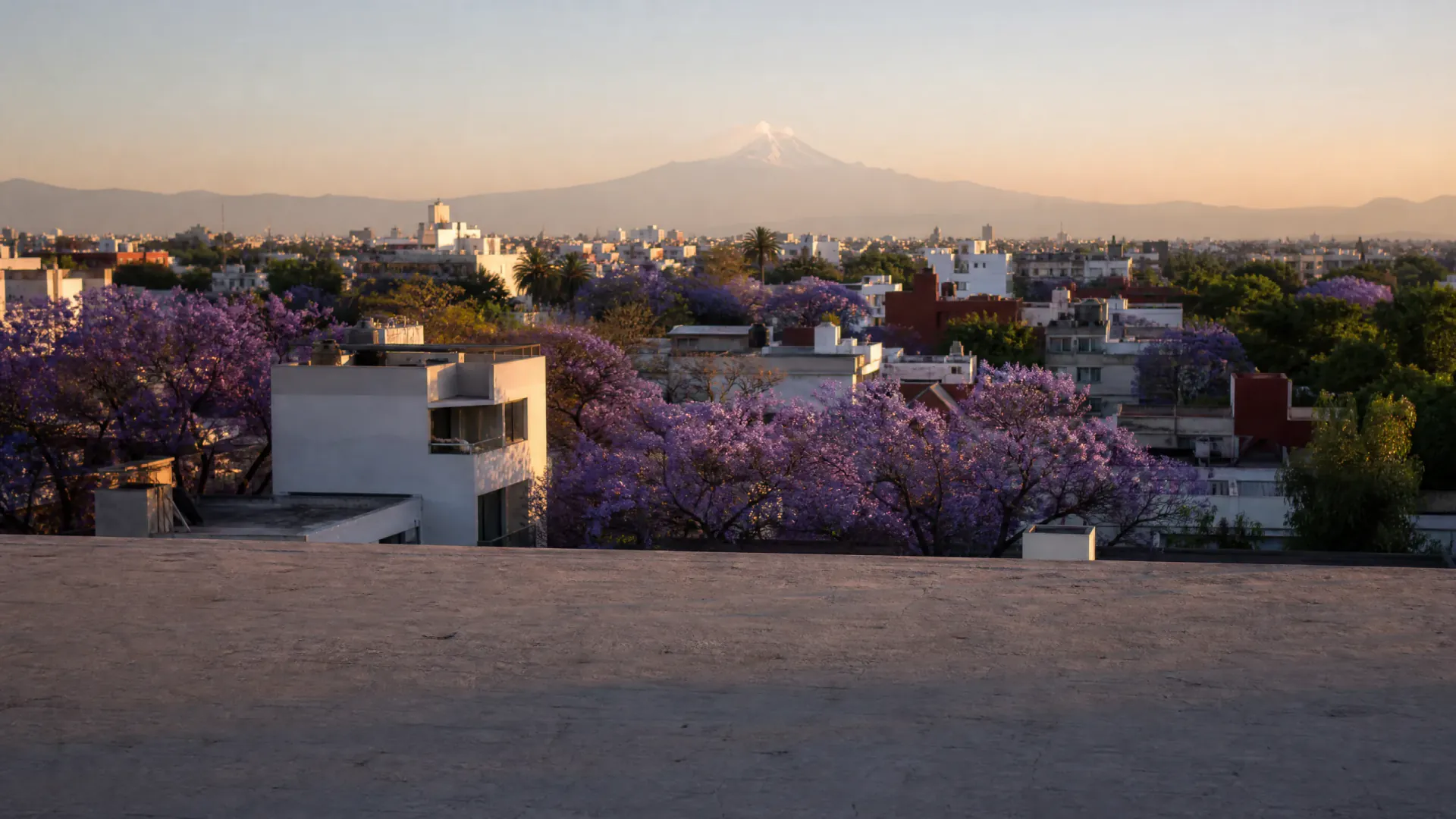
🇲🇽 Mexico for Digital Nomads: Live Your Dream. Work from Mexico.
Imagine half a year in Mexico City, one of the best places anywhere to savour great food, enjoy a mild climate and connect with an open international crowd. The trade-offs? Rising rents, uneven safety and a time zone far from Europe.
At a glance
| Monthly costs | Mexico City €1,400-2,200; Oaxaca or Mérida €1,000-1,600 |
|---|---|
| Internet | Fiber 100-500 Mbps for MXN 500-1,000 a month in the cities |
| Time zone | UTC-6 all year, no daylight saving time (Quintana Roo UTC-5) |
| Climate | Mexico City about 12-25 °C year-round; rainy season June-October |
| Residence route | Residencia Temporal: about US$4,400 net a month over 6 months, or about US$75,000-78,000 in savings over 12 months |
| Tax on foreign income | Residents taxed on worldwide income, up to 35% |
| Permanent residence | After at least 4 years of Residencia Temporal |
Why Mexico City stands out for digital nomads
Mexico City may be the best city in the world to spend six months in, and the one you’re never quite ready to say goodbye to.
From street stalls to world-class restaurants, every day gives you something to crave. The museums rival any European capital. Picture 20-25 °C all year, walkable neighborhoods with no car needed, and a large, social international community where finding your people feels wonderfully easy. Prices have risen in recent years, but remain well below Western Europe. This isn’t just somewhere to stay. It’s a life you could fall head over heels for.
But before you lose your heart, check one make-or-break detail: the clock. If your clients are in North America, Mexico fits your working day almost perfectly. If they’re in Europe, your overlap shrinks to the early morning. Check that single point before you imagine staying. Because the dream only feels this good when it actually works for you.
Everyday life
Mexico runs late, and that could be the luxury you’ve been craving. Breakfast starts around 9, lunch is at 3 or 4 pm and dinner begins at 9 pm. Find your rhythm, and reclaim long, quiet, productive mornings before the social side of life comes alive.
Daily life is warm, loud and deeply personal. Efficiency doesn’t come first here, people do. That slower pace isn’t carelessness; it reflects different priorities. It’s your invitation to exhale, loosen your grip and fall in love with another way of living.
Delivery services are everywhere and cheap, lifting everyday hassles off your shoulders. Uber works well in all larger cities and is by far the safest way to get around. The Mexico City metro is extensive and very cheap, if crowded.
Two frustrations remain: government offices and banking. Both can stretch your patience with slow processes, heavy paperwork and services rarely available in English. Expect these hurdles, even as you embrace everything else.
Where to live: find the base you’ll fall for
Mexico City is the center, and it pulls you in. Roma Norte, Condesa and Juárez are the obvious neighborhoods: old buildings, trees, cafés, restaurants and parks, all on foot. But that appeal comes at a price: they are also the most expensive and the most changed by newcomers. Craving quieter, more historic surroundings? Choose Coyoacán and San Ángel. Escandón and Narvarte are cheaper and less international. The city sits at 2,240 meters.
Oaxaca is smaller, colonial and the most interesting place in Mexico for food. Want more than life inside the international bubble? This is the better choice for going deeper. Just know the trade-off: weaker internet and less choice.
Mérida in Yucatán is considered the safest large city in Mexico. Picture a beautiful colonial center and a growing foreign community. The catch? Heat that turns oppressive from April to September.
Puerto Escondido and Sayulita on the Pacific coast bring that beach-life dream within reach, with a nomad presence in both. But expect much higher prices and bigger crowds than a few years ago.
Playa del Carmen and Tulum on the Caribbean coast offer large nomad scenes, but don’t let the dream overshadow the reality: they also have the biggest problems with prices, sargassum seaweed and safety.
Internet and coworking
Stay connected and keep your momentum: in the cities, connections are good. Fiber with 100-500 Mbps costs MXN 500-1,000 a month. Mobile internet is usable and cheap.
But outside the big cities, especially on the Pacific coast, unreliable connections can derail your day. In Puerto Escondido or Sayulita, a decent line is not a given, and power cuts happen. Working there? Carry a mobile backup for peace of mind.
Find your workday sweet spot: coworking in Mexico City is plentiful and good, at MXN 3,000-7,000 a month for a fixed desk. Prefer a café? Café culture is strong, and working from one is completely normal.
Food
Fall in love with one of the world’s great cuisines. Mexican food offers extraordinary regional depth: the rich moles of Oaxaca, the seafood of Baja California and the Gulf coast, the Maya-rooted cooking of Yucatán and the irresistible street food of Mexico City.
Eat exceptionally well, every single day. Tacos at a stand cost MXN 15-30 each, and a full set lunch at a fonda costs MXN 100-180. Craving something special? Top-end restaurants cost well below comparable places in Europe.
Enjoy first-rate produce without the hefty price tag: fruit, vegetables, chilies, corn, coffee from Chiapas and Veracruz, mezcal and tequila. Exceptional flavour, wonderfully affordable.
People, language and the rent debate
Mexicans are some of the warmest people you will meet: strangers are welcomed, invitations come easily, and families make room for outsiders as naturally as they do their own.
Spanish unlocks it all. English is spoken in the international neighborhoods of Mexico City and in tourism, and hardly anywhere else. Invest in a Spanish course in your first weeks, and after a few months, everyday life starts to click.
Mexico City has a large, mostly North American international community, and a very social one. There is a real opportunity to connect.
But do not fall in love with the lifestyle without facing this reality: the influx of foreign remote workers into Roma and Condesa has pushed rents up sharply and sparked real resentment among locals, including protests. Stay inside the bubble, and you are part of the problem. Speak Spanish, shop locally and spend time beyond the two fashionable neighborhoods, and a different country opens up to you.
Feeling the Cost-of-Living Squeeze?
| Item (MXN a month) | Mexico City | Oaxaca / Mérida |
|---|---|---|
| Furnished studio, good location | 14,000-24,000 | 9,000-16,000 |
| One-bedroom, Roma/Condesa | 22,000-40,000 | 13,000-24,000 |
| Food (markets and eating out) | 8,000-15,000 | 6,000-11,000 |
| Coworking, fixed desk | 3,000-7,000 | 2,000-4,500 |
| Fiber internet | 500-1,000 | 500-1,000 |
| Transport (Uber, metro) | 2,000-4,000 | 1,500-3,000 |
| Private health insurance | 1,500-4,000 | 1,500-4,000 |
Get honest about your budget now, or face a reality check that hurts. Realistically, you spend €1,400-2,200 a month in Mexico City and €1,000-1,600 in Oaxaca or Mérida. That dream of a cheap life in Mexico? Mexico is no longer a cheap country. Rents in the capital’s popular neighbourhoods have risen sharply in just a few years. Build your plans around figures from before 2021, and you’re setting yourself up for bitter disappointment.
Hoping exchange rates will save your budget? Don’t stake your plans on it. The peso has proved surprisingly robust, so earning in foreign currency gives you no exchange-rate advantage.
And banking? Prepare for a serious test of patience. Opening a Mexican bank account without a residence permit is practically impossible, and even with one, it’s tedious. The everyday reality? You live on foreign cards.
Health and safety
Your wellbeing matters, especially far from home. Private healthcare in Mexico City, Monterrey and Guadalajara is good, with modern clinics and short waiting times. Dentistry is excellent and cheap, too. In smaller cities, options thin out quickly. Don’t gamble with your health: an international health policy is a must. Start with health insurance for digital nomads.
You deserve to feel informed, not frightened, or falsely reassured. Safety conditions vary enormously by region. Some states have violence levels comparable to war zones, while Yucatán is statistically safer than some regions of Europe. Knowing the difference matters.
Imagine exploring with greater confidence. Mexico City, Oaxaca, Mérida and Guanajuato are manageable for newcomers in daily life when you make these essential habits second nature:
- No street taxis, always Uber.
- No long walks at night in neighborhoods you do not know.
- No visible jewelry and no phone in your hand on the street.
- No travel to states with official travel warnings.
Protect the experience you’ve been dreaming of. The risk is less about random violence than situations you can walk into. These habits help you avoid trouble, though no precautions guarantee safety. Take your first step towards greater confidence with our digital nomad safety tips.
Before you fall in love with a rental, remember: earthquakes in Mexico City are real. The city stands on a former lake bed, amplifying the shaking. There is a good early warning system. Ask when the building was built before you rent. Your peace of mind is worth that question.
Climate and altitude
Imagine enjoying one of the most pleasant year-round climates of any major city. That’s Mexico City. At 2,240 meters, temperatures stay between about 12 and 25 °C all year. From June to October, the rainy season mostly brings heavy afternoon storms. The everyday luxury? You need neither air conditioning nor heating.
But give yourself time to settle in. The altitude makes those first days noticeably tiring, and exercise feels harder for weeks. If you have circulation problems, plan for it. The reassuring part: most bodies adapt within two to three weeks.
Fresh-air dreams deserve the full picture: air quality in Mexico City is a seasonal issue, especially in the dry season from February to May.
Craving tropical warmth? The coasts deliver: Yucatán is hot and humid, with hurricane season from June to November. The Pacific coast is similar, with November to April the best time to enjoy it.
Getting around and the time zone
Explore more without draining your budget: flying within Mexico is cheap, and the long-distance bus network is surprisingly comfortable.
Enjoy the freedom of knowing exactly where your day stands. Most of Mexico, including Mexico City, is on UTC-6 all year. The country dropped daylight saving time in 2022. Quintana Roo, home to Tulum and Playa del Carmen, stays on UTC-5 all year.
For clients in North America, you’re close to their business day, making staying connected feel that much easier. For clients in Central Europe (UTC+1, UTC+2 in summer), you are seven to eight hours behind: your whole overlap falls in your early morning. Imagine clearing European calls at 7 or 8 am, then having a long, quiet day ahead. That rhythm can work beautifully. The trade-off? If you must be available in the European afternoon, you work at night.
Entry and the Residencia Temporal
Your dream of Mexico deserves more than “one day”. Whether you can enter without a visa depends on your passport. Visitors can be granted up to 180 days at entry, but that is a ceiling, not a promise. Officers increasingly grant shorter periods, sometimes 30 or 60 days. Don’t leave your arrival to chance: carry proof of accommodation, an onward or return flight and funds.
Imagine the freedom of settling in, not counting down. Your route is the Residencia Temporal. Mexico has no digital nomad visa strictly speaking, but residence through economic solvency serves the same purpose: one to four years of residence, with remote work for foreign clients allowed and work for Mexican employers not allowed. Turn “someday” into your next step on our Mexico visa page.
Don’t let unexpected requirements derail your dream: the conditions tightened considerably in 2026:
- Income: about US$4,400 net a month, shown over six months, or about US$75,000-78,000 in savings or investments over twelve months. Since July 2025 the thresholds have been calculated in UMA, Mexico's unit of account, whose 2026 value was published on 8 January 2026.
- Exchange rates: protect your peace of mind; consulates convert at different rates, so ask yours for the exact figure.
- Fees: keep your budget on track; processing fees were doubled by a law of November 2025.
- Permanent residence: build your future with your eyes open. Under the guidelines of July 2025, direct permanent residence through economic solvency is limited to retirees and pensioners. Remote workers, freelancers and people living on capital income must go through temporary residence first, for at least four years.
Your new chapter starts with a clear plan: apply at a Mexican consulate outside Mexico. Within 30 days of entering, exchange the visa for a residence card at the immigration institute INM. Give this life-changing move the time it deserves: expect waiting times, and expect consulates to differ in the proof they ask for.
Taxes in Mexico
Picture the life you could build in Mexico. Now protect that dream by understanding what comes with it: Mexico taxes residents on their worldwide income. You become resident when your center of vital interests is in Mexico; indicators include more than half of your income coming from Mexican sources or your main professional activity being there. Unlike many countries, Mexico has no fixed 183-day rule for individuals.
Don’t let this crucial difference catch you off guard: unlike Panama, Paraguay or Costa Rica, Mexico does not tax on a territorial basis. Income tax is progressive and reaches 35%.
Your fresh start deserves peace of mind, not unwelcome surprises. If you stay as a visitor for under 180 days and do not move your center of vital interests, you usually have no Mexican tax liability. Take the Residencia Temporal and live there long term, however, and taxes need serious attention: you will usually have to register with the tax authority SAT. Before you commit, check whether a tax treaty exists between Mexico and your home country.
Choose Mexico because you love the life waiting there, not because you expect a tax break. Because Mexico taxes in full, it is not a low-tax base. Becoming resident there is a life decision, not tax planning.
Protect what you’re building: invoicing and residence are separate questions. A lean US LLC setup needs careful review if you live in Mexico, because Mexico taxes its residents fully.
Your tax situation at home
Moving to Mexico can feel like a fresh start, but it does not automatically end your tax residence at home. Your home country's rules determine whether you remain taxable there.
US citizens remain subject to US income tax on their worldwide income, wherever they live (IRS).
Protect your fresh start: settle residence and structure before the move, not after. Getting this wrong is hard to repair later. Get clarity with our guide on where digital nomads pay taxes, which explains how home country, host country and tax treaties interact.
Is Mexico right for you?
Imagine waking up in one of the world's great cities, and knowing you’re home. Incredible culture. Unforgettable food. A social life that makes you feel alive. If that matters more than your tax rate, and your working hours fit the time zone, Mexico could be everything you’ve been craving. Work asynchronously? Mexico City is hard to beat.
But don’t let the dream drown out your deal-breakers. European afternoon meetings, a low tax burden or safety without grey areas? Mexico may not be the right place for you, and that matters.
Craving Latin America without feeling so far from European hours? Explore Colombia and Brazil; Brazil is only four to five hours behind Central Europe. Argentina is the third serious option.
Frequently asked questions
Does Mexico have a digital nomad visa?
Not strictly speaking, but your Mexico dream is within reach. Remote workers use the Residencia Temporal through economic solvency: in 2026 about US$4,400 net a month over six months, or about US$75,000-78,000 in savings over twelve months. Your next chapter starts by applying at a Mexican consulate abroad.
Do digital nomads pay taxes in Mexico?
Only if they become resident, so don’t let tax uncertainty steal your freedom. Mexico taxes residents on worldwide income at up to 35% and looks at your center of vital interests, not a 183-day count. Your peace of mind? Visitors who stay under 180 days without moving their center of vital interests usually owe no Mexican tax.
How much does it cost to live in Mexico City?
Picture your life here: realistically, €1,400-2,200 a month, or €1,000-1,600 in Oaxaca or Mérida. But don’t let outdated budgets derail your dream: rents in popular neighborhoods have risen sharply, so figures from before 2021 no longer apply.
Is Mexico safe for digital nomads?
Your dream life in Mexico starts with choosing the right region. Mexico City, Oaxaca, Mérida and Guanajuato are manageable if you use Uber instead of street taxis, avoid long walks at night in unknown areas, keep valuables out of sight and skip states with travel warnings.
What time zone is Mexico City in?
Stay connected with ease: UTC-6 all year, since Mexico dropped daylight saving time in 2022. Quintana Roo, with Tulum and Playa del Carmen, is on UTC-5. Perfect for keeping close to North American clients; Central Europe is seven to eight hours ahead.
Planning a move to Mexico?
A season in Mexico, or a place to call home?
Make your Mexico dream a confident next step. Discover whether a visitor stay is enough or Residencia Temporal fits better, what residence in Mexico means for your taxes, and which steps to take before you move.
Book a consultation