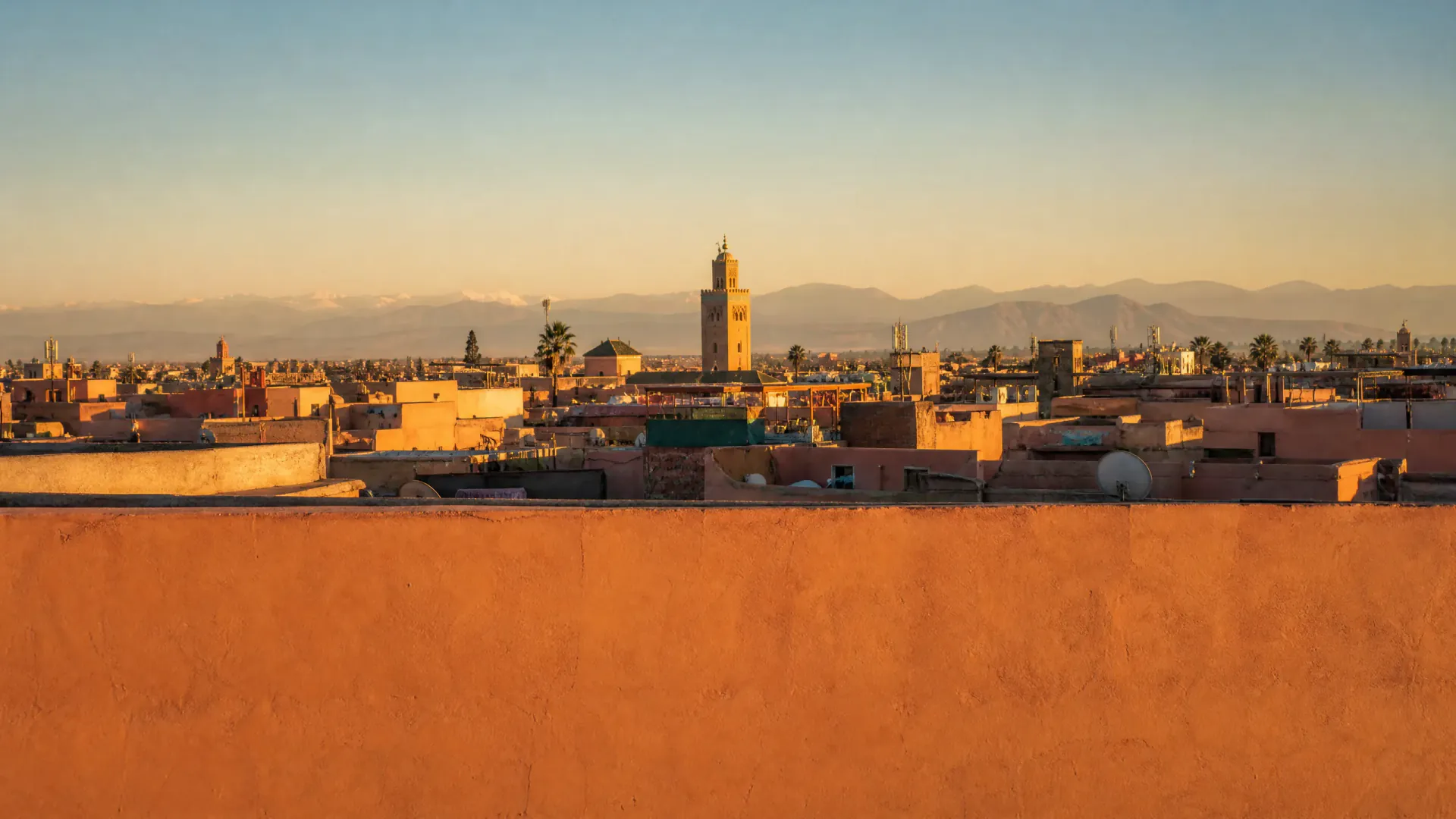
🇲🇦 Digital Nomads in Morocco: Your Dream Winter Sun Escape Close to Europe
A short flight from Europe, Morocco opens the door to a different world: incredible food, low costs and almost no time difference to European clients. The dream comes with trade-offs: paperwork, a closed currency and the language question.
At a glance
| Monthly costs | €1,100-1,700 in Marrakesh or Casablanca; €900-1,400 in Taghazout or Essaouira |
|---|---|
| Internet | 30-100 Mbit fiber in the big cities for MAD 300-700 a month |
| Time zone | UTC+1 all year; UTC+0 during Ramadan |
| Best season | November to April |
| Visa route | No digital nomad visa; visa-free stay depending on your passport, then the Carte de Séjour |
| Tax on foreign income | Resident after more than 183 days in any 365-day period; worldwide income, progressive up to 37% |
Why digital nomads choose Morocco
If your clients are in Europe, one reason to choose Morocco outshines the rest: a short flight takes you into another world, while your clock barely changes.
Picture January: you’re soaking up the sun in Marrakesh at 20°C. Your European clients reach you at the usual times, your calendar stays the same, and if something comes up, you can be back in Europe the same day. But the feeling? Worlds apart. Morocco isn’t a warmer Europe. It feels like its own continent, one that happens to be beautifully close.
And the landscapes? Atlantic surf, a Mediterranean coast, the snowy High Atlas, the desert, and cities stretching from medieval medinas to a modern business capital. So much to discover. So close to home.
The trade-offs are real: health care with gaps, a currency you cannot freely convert, and a country where, without French or Arabic, much of what you experience stays on the surface.
Everyday life
Breathe out. Feel the rush fall away. Moroccan daily life feels more personal and unhurried than many visitors expect. Greetings deserve a moment. Tea asks you to stay. Even bargaining becomes part of everyday life, not just in the souk.
Feel your days find a different rhythm, shaped by prayer and, in Marrakesh and other hot cities, the heat: mornings for work, peaceful afternoons, evenings bursting with energy. During Ramadan everything shifts.
And the freedom to explore? Closer than you think. Ride apps such as InDrive, Careem and Bolt are available and cheap in the cities. The train between Tangier, Rabat, Casablanca and Marrakesh is good, while the high-speed line in the north is the fastest in Africa.
The reality check? Government offices, banking and anything involving paperwork can still leave you drained. And cash? It still plays a very large role.
Where to base yourself
Marrakesh is the obvious choice, and you’ll soon feel why. The medina and its riads draw you into a world of their own. For living and working, though, Gueliz, the French-built new town, is usually the better address: wide streets, cafés, coworking and reliable internet. Add the country’s largest international presence and the Atlas just an hour away, and everyday life feels full of possibility.
Casablanca is the business capital: loud, big and not charming, but built to help you get things done. Expect the best infrastructure, the most reliable internet and the widest coworking choice.
Taghazout and Agadir on the Atlantic are where surf meets the lifestyle you’ve been craving. Taghazout, a former fishing village, has become a small hub for surfers and remote workers, with coliving, yoga studios and an international scene. Mild temperatures all year make this region Morocco's best winter base.
Essaouira is windy, relaxed and artistic: a lovely medina, a small foreign community and room to focus, excellent for focused work. Prefer calm? Rabat is calm, clean and administrative. Tangier in the north is on the rise, while Chefchaouen offers the simple appeal of somewhere beautiful and small.
Internet and working
Stay connected, and keep your work moving. City connectivity ranges from usable to good. 30-100 Mbit fiber is standard in Casablanca, Marrakesh, Rabat and Agadir and costs MAD 300-700 a month. Slower and pricier than many places? Yes. But enough for video calls, and that matters.
Give yourself the reassurance of a backup. Mobile coverage is reliable in populated areas, and 5G has launched in selected parts of the big cities. A local SIM is strongly recommended: it is cheap and backs you up. Coverage thins out in rural areas, the Atlas and smaller coastal towns; in Taghazout or Essaouira, test the line before you sign.
Find your space, find your rhythm. Coworking is good in Casablanca, decent in Marrakesh and Agadir, and rare elsewhere. Settling in for hours? That is more common in modern cafés than in traditional ones.
Food
Get ready to fall head over heels for one of the world's great cuisines. Moroccan cuisine tempts you with tagines in dozens of versions, couscous on Fridays, harira, pastilla, grilled fish on the coast and a long list of salads and starters. Delicate spices make every bite sing, with sweet and savory often coming together in one dish you'll never forget.
It is very cheap: a good meal in a local restaurant costs MAD 50-120. Expect to pay much more in tourist centers and upscale places.
Two things to know before you go: alcohol is available but expensive and not everywhere, and international food is limited outside Casablanca and Marrakesh. Mint tea isn't just a drink, it's an invitation to connect; turning it down means more than declining a drink.
People and community
Moroccans welcome you with warmth, humour and an infectious love of company. Invitations come quickly, and they genuinely want you to say yes.
But here’s what truly opens doors: language. Without French, a lot stays on the surface. French is the language of business, administration and the educated middle class. Speak it, and a different country opens up to you. English is spreading among younger people and in tourism, but remains far less common. Still remember some school French? Brush up on it; you’ll feel the payoff straight away.
In tourist centers, especially the Marrakesh medina, dealings with foreigners are heavily commercial: constant approaches, pushy sales and inflated prices. But head to Gueliz, Casablanca, Essaouira or the countryside, and discover a different Morocco. Looking for international connections? The international community is largest in Marrakesh, mostly French, while Taghazout is attracting a growing number of remote workers.
Your money. Your costs. Your currency.
| Item | Marrakesh | Casablanca | Taghazout / Essaouira |
|---|---|---|---|
| Furnished studio, good location | MAD 4,000-7,000 | MAD 5,000-8,500 | MAD 3,500-6,500 |
| One-bedroom apartment | MAD 6,000-11,000 | MAD 7,500-14,000 | MAD 5,000-9,000 |
| Groceries and eating out | MAD 3,000-5,500 | MAD 3,500-6,000 | MAD 3,000-5,000 |
| Coworking, fixed desk | MAD 1,200-2,500 | MAD 1,500-3,000 | MAD 1,000-2,000 |
| Internet | MAD 300-700 | MAD 300-700 | MAD 300-700 |
| Transport | MAD 600-1,500 | MAD 700-1,800 | MAD 800-1,800 |
| Private health insurance | MAD 500-1,500 | MAD 500-1,500 | MAD 500-1,500 |
Imagine the life you could enjoy for €1,100-1,700 a month in Marrakesh or Casablanca and €900-1,400 in Taghazout or Essaouira. A good apartment. Meals out. Coworking. This is a realistic budget for that life, and if you live frugally, you can spend much less.
But protect your freedom, and your savings: the dirham is not freely convertible and is state-controlled. Buying or selling it outside Morocco is difficult, and taking larger amounts out is restricted. Do not hold savings in dirham: use foreign cards and change only what you need. Ready to put down roots? A Moroccan bank account is possible once you have a Carte de Séjour.
Health and safety
Your peace of mind matters, but health care is split. Private clinics in Casablanca, Rabat and Marrakesh are solid for everyday cases and many procedures, with French-speaking staff and moderate prices. For complex diagnoses, people usually head to Europe, about three hours away by plane. Protect yourself when it matters most: your insurance should cover evacuation and treatment in Europe. Explore our page on health insurance for digital nomads.
Feel more confident about everyday life: safety is good. Violent crime against foreigners is rare, and Morocco is very stable by regional standards. Still, stay alert to scams, pickpocketing and pushy approaches in tourist zones. For women traveling alone, verbal harassment is common, though physical assault is rare.
One legal detail you shouldn’t overlook: Morocco has laws on extramarital relationships and on religion. They’re rarely applied to foreigners, but they do exist. Discretion is the sensible approach.
Climate
The Atlantic coast around Agadir, Taghazout and Essaouira is the balance you’ve been craving, with 18°C to 27°C all year, refreshing ocean breezes in summer and mild, sun-filled days in winter. For year-round living, it is the best place in the country.
Marrakesh lifts your spirits from November to March, with glorious sunshine and 18°C to 24°C. Summer from June to September is brutal, regularly above 40°C. Casablanca and Rabat stay mild all year, though winter is damper and grayer, while the High Atlas has snow from December to April.
Morocco is your winter escape: excellent from November to April, exactly when Europe is at its worst, and you’re longing to feel the sunshine again.
Getting there and the time zone
Your Moroccan escape is closer than you think. Marrakesh, Casablanca, Agadir, Fez and Tangier have frequent direct flights from many European cities, with both full-service and low-cost airlines. From Central Europe, you could be there in around three to four hours. And prices? Low, especially in winter.
Morocco is on UTC+1 all year. Less clock-watching, more enjoying: in the European winter you share the time of Paris, Berlin or Rome; in the European summer, when Central Europe moves to UTC+2, you are just one hour behind.
One little detail to plan for: for Ramadan, Morocco moves back to UTC+0 and then forward again afterwards. During that period the gap to Central Europe grows by an hour. Pop it in your calendar, then get back to dreaming about your escape.
Entry and the Carte de Séjour
Ready to make Morocco your next chapter? Your passport determines whether you can enter without a visa, and how long you can stay.
There is no dedicated digital nomad visa in 2026. Morocco has announced one now and then, but never introduced it. Don’t build your dream around a visa that doesn’t exist: our Morocco digital nomad visa page explains what works instead.
For longer stays, the Carte de Séjour is your route: the residence card under the foreign nationals law.
- One year at first, then renewed annually; after several years, cards valid for five or ten years are possible.
- Apply at the prefecture where you live, not in advance from abroad.
- You’ll need a certified lease or proof of ownership, proof of income, a medical certificate issued in Morocco, passport photos and a criminal record certificate.
- Fees are low, a few euros. Processing officially takes about five weeks, but often takes longer.
Expect bureaucracy, piles of paperwork and frustrating inconsistency. Requirements differ by prefecture and officer, requests for more documents are normal, and without French, navigating it alone is hard.
The common alternative? A border run at the end of each visa-free stay. It works, but it is not a right: border officials have the final word, and Morocco can refuse re-entry if repeated short exits stand out. Don’t leave your longer-term plans hanging at the border. If you want to stay longer than six months, apply for the Carte de Séjour.
Tax in Morocco
Fall in love with Morocco, but know that residents are taxed on their worldwide income. Income tax is progressive with a top rate of 37%. The 2025 Finance Act raised the tax-free allowance to MAD 40,000, and the 2026 Finance Act left the scale unchanged.
Your dream move deserves clarity: you are tax resident if your habitual home or the center of your economic interests is in Morocco, or if you spend more than 183 days in the country within any 365-day period. That is a rolling period, not the calendar year, so every day matters.
Two costly misunderstandings could catch you out. First, residence permits and tax residence are separate. You can be tax resident without a Carte de Séjour if you spend 200 days in the country, and not resident with one if you arrive in October and stay sixty days. Second, the auto-entrepreneur status offers freelancers a very favorable flat tax, but it is capped at annual revenue of MAD 200,000 for services. Go above that, and you risk reclassification and back taxes.
Choose Morocco for a richer quality of life, not tax savings. Below the 183-day threshold, Morocco does not tax your foreign income. Above it, protect your peace of mind: have your situation checked. Explore the tax guide to Morocco for the regimes available to longer-term residents.
Your tax at home
For most readers, Morocco means a winter escape, not a change of residence. But don’t let the sunshine catch you off guard: leaving a country does not automatically end your tax residence there. Whether you remain taxable at home depends on your home country's own rules. Making Morocco your main home? Remember the top rate of 37%: you gain climate, costs and proximity to Europe, but not a lower tax rate.
If you are a US citizen, your US income tax obligations follow you: your worldwide income remains subject to US income tax wherever you live (IRS). Get clarity before you go: our guide on where digital nomads pay taxes explains how home country, host country and treaties fit together.
Is Morocco right for you?
Imagine swapping the European winter for Morocco’s sun and warmth, without jet lag or a long flight. If cultural difference excites you, great food and low costs matter to you, and you speak French or feel ready to learn, Morocco could be the change you’ve been craving.
But your dream move needs to feel right. Morocco is less suited to you if you have no French and don’t want to learn, find pushy commerce in tourist zones draining, or want a tax-efficient residence.
Want the same time zone with more urban infrastructure? Explore Turkey. Craving summer during the European winter with better health care? Consider South Africa, but expect a much longer flight. Or discover Cape Verde, the smaller, warmer alternative further south.
Frequently asked questions
Does Morocco have a digital nomad visa?
No. There is no dedicated digital nomad visa in 2026, but your Morocco dream is still within reach. Remote workers use their visa-free stay, which depends on their passport. Want to stay longer? Apply for the Carte de Séjour at the prefecture where you live.
How much does a month in Morocco cost for a digital nomad?
Your Morocco dream can be real: €1,100-1,700 a month in Marrakesh or Casablanca and €900-1,400 in Taghazout or Essaouira, with a good apartment, eating out and coworking. Just protect your savings: the dirham is not freely convertible, so do not hold savings in it.
When do I have to pay tax in Morocco?
Don’t let a surprise tax bill derail your plans. Spend more than 183 days in Morocco within any 365-day period, and you become tax resident, among other tests. Residents pay tax on worldwide income at up to 37%. Below the threshold, Morocco does not tax your foreign income. Know where you stand, before you make your move.
What are the best places for digital nomads in Morocco?
Find your perfect rhythm: Gueliz in Marrakesh for vibrant city life, Casablanca for the best infrastructure, Taghazout and Agadir for surfing and mild weather all year, and Essaouira for the peace to do quiet, focused work.
Spending the winter in Morocco?
Enjoy Morocco without losing control of your tax residence
Morocco counts days in any 365-day period, and residence permits and tax residence are separate questions. Don’t leave your peace of mind to chance. We help you plan your stays and check where your tax residence sits.
Book a consultation