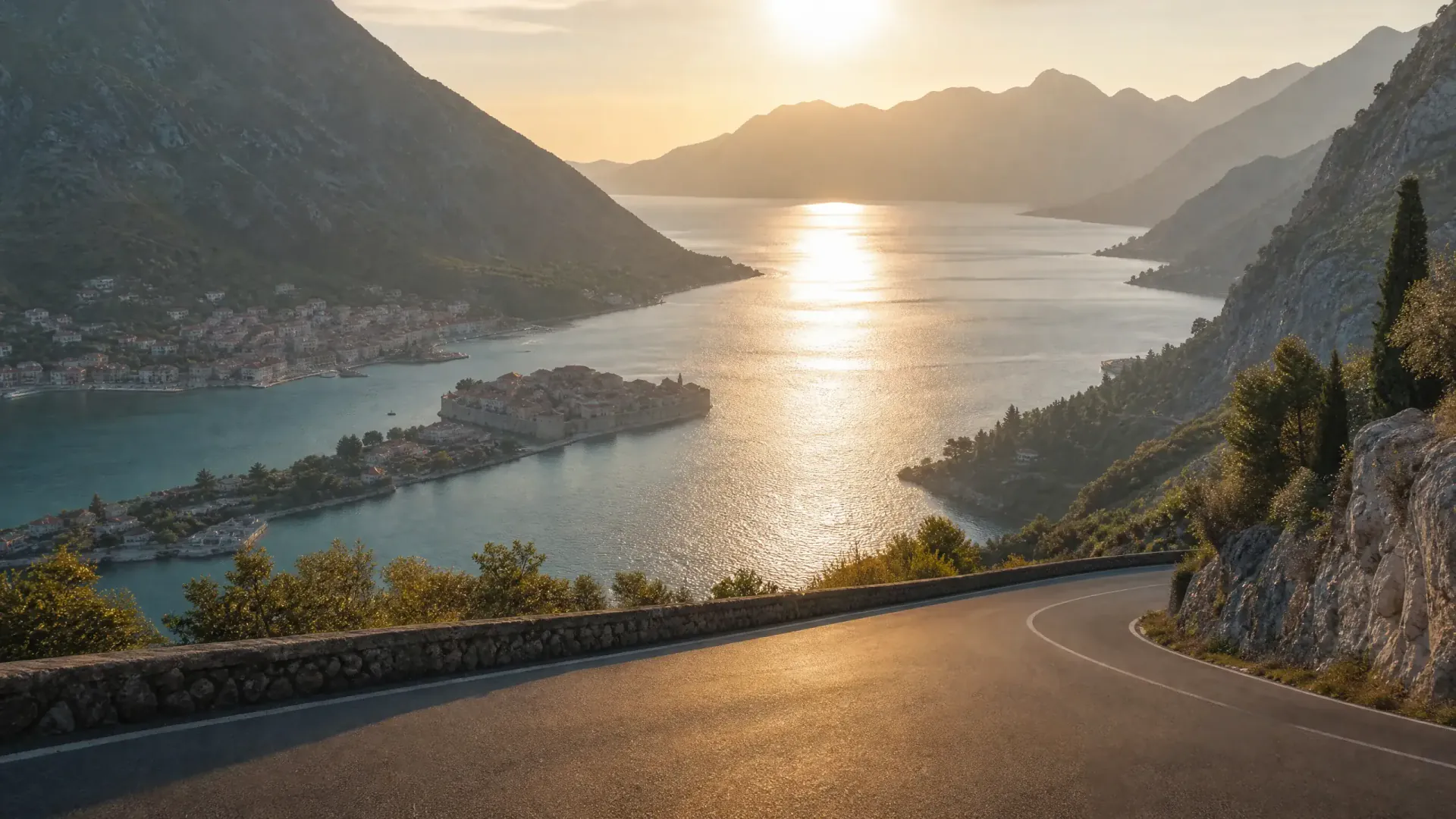
🇲🇪 Montenegro for Digital Nomads: Live Your Adriatic Dream on a Remote Work Permit
Imagine calling Montenegro home: a stunning Adriatic coast, soaring mountains, and the ease of the euro. Remote workers can enjoy a residence permit of up to four years, with foreign earnings free of local income tax. One crucial catch before you fall in love: it never leads to permanent residence.
At a glance
| Monthly costs | Coast €1,100-1,700; Podgorica €900-1,400 |
|---|---|
| Internet | Fiber 100-300 Mbps for €25-45 a month |
| Time zone | UTC+1, UTC+2 in summer |
| Best season | May-June and September-October |
| Residence route | Digital nomad permit: up to 2 years, renewable once (max 4 years) |
| Income threshold | 3x the minimum wage, about €1,800-2,400 a month |
| Tax on foreign income | Remote income from clients not registered in Montenegro exempt from income tax and social contributions |
| Permanent residence | Not via the nomad permit |
Montenegro for digital nomads at a glance
Imagine keeping more of what you earn, and living somewhere that takes your breath away. Montenegro offers remote workers a residence permit of up to four years, with earnings from foreign clients not subject to Montenegrin income tax. Your backdrop? One of the most beautiful coastlines in Europe, mountains that hold their own against Norway, and the convenience of the euro as the national currency, even though Montenegro is not a eurozone member.
But before you fall in love, know the structural catch: the nomad permit does not lead to permanent residence. It runs for four years at most, followed by a six-month break. That means the five uninterrupted years needed for permanent residence never add up on this route. A remarkable chapter? Absolutely. A route to permanent residence? No.
Everyday life
Montenegro is small: about 620,000 people, and you can cross the whole country in a day. No anonymity, no big city, not much choice. But the trade-off? Space to build a life that feels like yours.
What you gain takes your breath away: extraordinary landscapes, wonderfully close together. Swim in the Bay of Kotor in the morning, then hike at 2,000 meters in Durmitor National Park in the afternoon. One day. Both worlds. Yours to enjoy.
Let the relaxed Mediterranean pace draw you in: long coffees, and appointments that are suggestions. Give yourself a few weeks to accept the pace of the bureaucracy. The adjustment is real, but so is the chance to slow down.
And here’s one less thing to worry about: the euro is legal tender. If you earn in euros, you carry no currency risk and do no conversions. Less friction, every day, an underrated advantage over Albania, Serbia or Turkey.
Where to live: find the place that feels like home
Kotor steals your heart at first sight: a Venetian-style old town at the end of the bay, wrapped in breathtaking, steep mountain walls. But summer brings overwhelming cruise crowds, while winter leaves it almost empty. Want somewhere that truly feels yours? Discover the bay villages: Dobrota, Perast or Prčanj.
Tivat lets you breathe out and enjoy everyday life. The Porto Montenegro marina has brought international infrastructure: restaurants, shops, gyms and a foreign community that stays all year. With the airport next door, it is the obvious choice for a year-round base.
Budva is loud, crowded and tourist-focused, rarely the right place to find your rhythm, settle in and work.
Podgorica is the capital: functional rather than pretty, but the only city offering urban infrastructure, cheap rents and normal year-round life. With government offices and doctors close by, practical peace of mind matters more than picture-perfect streets.
Herceg Novi, at the northern end of the bay, invites you into a greener, quieter life year-round, with an established foreign community helping you feel less alone, and more at home.
Internet and coworking
Your coastal work-life dream doesn’t have to mean sacrificing a good connection. Connections are good in the coastal towns and in Podgorica, with fiber at 100-300 Mbps costing €25-45 a month. Mobile internet is solid too, and data plans have become affordable since the regional roaming agreement and Montenegro's gradual alignment with EU rules.
Dreaming of working from the mountains or smaller villages? Coverage gets much thinner there. Before you make Durmitor or the north your office, test the connection first.
Coworking is sparse: Tivat, Kotor and Podgorica have a few spaces, but no dense market. The good news? Working from home or cafés is completely normal here, and it’s what most people do. You can settle into your own rhythm, with power cuts that happen but are rare and short.
Food
Montenegrin food brings the Adriatic and the Balkans straight to your plate. On the coast, savour the Mediterranean: fish, seafood, olive oil and vegetables, simply grilled, nothing overdone. Picture a fish dinner by the water, wine in hand, for €20-35 per person in a simple restaurant, Italian quality for a fraction of Italian prices. Inland, tuck into hearty, cheap food: grilled meat, regional cheese, kajmak and prosciutto from Njeguši.
Taste the goodness of produce that often comes from small farms. Wine from the Vranac grape delivers solid quality without the hefty price, with a growing number of small producers to discover.
The catch? Variety. Outside Tivat and Budva, international food barely exists. Craving Asian, Indian or ambitious vegetarian cooking? You’ll hit limits fast. After three months, you know the menu.
People and community
Feel the warmth of Montenegro: Montenegrins are hospitable, proud and remarkably relaxed, less effusive than Albanians, but with a welcome that puts you at ease.
English is common on the coast and among younger people, making it easier to connect. You will also hear plenty of Russian: a large Russian-speaking community has long called this country home and has grown markedly since 2022.
But come for the country, not a ready-made nomad scene. Montenegro has newcomers, sailors and property buyers, but no real nomad scene or network of coworking spaces, meetups and community events like those in Lisbon, Tbilisi or Chiang Mai. Want an instant social circle? You will be disappointed. Prefer to build your own connections or feel content with little contact? You will find a very pleasant country, and the freedom to enjoy it your way.
Cost of living
Dreaming of the Adriatic? Montenegro is cheaper than the EU side of the Adriatic, but more expensive than Albania.
| Item (€ a month) | Tivat / Kotor | Podgorica |
|---|---|---|
| Furnished studio, good location | 400-700 | 300-500 |
| One-bedroom with a view | 600-1,100 | 400-700 |
| Groceries and eating out | 400-650 | 350-550 |
| Coworking, fixed desk | 120-200 | 100-170 |
| Fiber internet | 25-45 | 25-45 |
| Rental car | 400-700 | 400-700 |
| Private health insurance | 60-160 | 60-160 |
Picture your life by the sea, with a realistic budget of €1,100-1,700 a month on the coast or €900-1,400 in Podgorica. Just don’t overlook the car: on the coast, it’s practically a must, with limited public transport and towns spread out.
The biggest budget shock? Seasonality. In July and August, coastal rents soar, in some cases to two or three times the usual level. Want to keep more money for the life you came for? Renting for the whole year gets you a much better deal.
Your dream of owning property is within reach: the market is open to foreigners. But plan carefully: the rules on company formation and property purchase as a basis for residence were tightened noticeably in January 2026.
Health and safety
Your health is too important to leave to chance. Healthcare is Montenegro’s weak spot: the public system is poorly equipped, and private clinics are few, mostly in Podgorica and on the coast. Everyday problems? Usually manageable. But for serious diagnoses, people usually head to Belgrade, Zagreb, Vienna or Ljubljana.
Give yourself peace of mind before you arrive. As a nomad permit holder, you have no access to the public health system, so you need private cover. Your policy must include medical evacuation; for Montenegro, that is not optional. Protect yourself: see health insurance for digital nomads.
Now, the reassurance you want: everyday safety is excellent. Montenegro is one of the safest countries in Europe, and violent crime against foreigners is practically unknown. That is a real reason to breathe easier.
Behind the wheel, though, do not let your guard down. The real risk is the road: the coastal road is narrow, winding and busy, driving is aggressive, and accident numbers are high for the size of the population.
Climate and seasons
Craving that Mediterranean sunshine? The coast brings hot, dry summers of 30 °C and more, but mild winters come with serious rain. The Bay of Kotor is one of the rainiest places in Europe: prepare for weeks of winter rain. Dreaming of snowy adventure instead? The northern mountains offer a continental climate, harsh winters and skiing.
- Best time: May to June and September to October. Savour the sweet spot: warm days, space to breathe and moderate prices.
- July and August: expect intense heat, crowds and high prices. Cruise ships can make Kotor's old town feel unbearable at times.
- Winter: the coast turns very quiet, many restaurants close and relentless rain can take its toll. Making this your year-round home? Choose Tivat, Herceg Novi or Podgorica, where life keeps going through winter.
Getting there and the time zone
Your move feels closer when getting there is this straightforward. Tivat and Podgorica have direct flights to a number of European cities, many of them seasonal. In winter the schedule thins out, with connections often through Belgrade, Vienna or Zagreb. Dubrovnik in Croatia is a well-connected alternative, one and a half to two hours away by car.
A new life doesn’t have to mean shifting your working day. Montenegro is on UTC+1, and UTC+2 in summer, the same as Central Europe. If your clients are in Europe, you work their day without any shift.
Entry and the digital nomad permit
What if Montenegro wasn’t just an escape, but the life you finally said yes to? How long you can stay without a visa depends on your passport. Dreaming of longer? Montenegro runs a digital nomad program, implemented as a temporary residence permit with its own government portal. Discover the full details on our Montenegro visa page. Here’s what could shape your next chapter in 2026:
- Duration: stop counting down to goodbye: stay for up to two years, renewable once for the same period, so up to four years in total.
- Income: your gateway requires more than three times the Montenegrin minimum wage. In 2026 the minimum wage is €600 or €800 depending on qualification level, which means about €1,800-2,400 a month.
- Work: take the work you love with you, remotely serving clients outside Montenegro. Work for Montenegrin companies is excluded.
- Housing: give your dream an address: proof of a rented or purchased home in Montenegro is already required when you apply.
- Documents: get one step closer with your health insurance and a criminal record certificate ready.
- Where: already feeling at home? If your passport allows visa-free entry, you can apply from inside Montenegro during that stay.
- Family: share this new beginning: spouses and children can join you.
- Processing: the law provides for a decision within 40 days of a complete application.
Let yourself dream, but know these three limits before you commit. Time on the nomad permit does not count toward permanent residence. You get no access to the public health system. And Montenegro is not in the Schengen area: the permit gives you no right to live in the EU, while days spent in Montenegro do not count toward the Schengen 90-day limit.
Is the program ending in 2026?
Worried your chance is slipping away? Nomad websites claim the program ends in late 2026. But no primary source says so. That date comes from a government strategy paper, the "Program for attracting digital nomads until 2025", which was never a legal basis. The actual legal basis is the Foreigners Act, and the new act (Sl. list CG 3/2026, in force since January 2026) continues the nomad permit with no end date. The tax exemption for remote income (Sl. list CG 152/22) has no expiry date either.
Still, don’t leave your plans hanging on “someday”. Programs can change, especially in a country on the path to EU membership, and a permit you hold is better than one you plan to apply for. Give yourself two to three months in total for documents, translations, apostilles and processing, and start turning your plans into reality.
Taxes in Montenegro
Keep more of what you work so hard to earn. Montenegro taxes residents on their worldwide income, but income tax is low and progressive, at rates of 9-15%, with corporate tax in the same range. That puts Montenegro among the low-tax countries of Europe.
For nomad permit holders, here’s the real draw: an explicit exemption in the income tax law. Income that permit holders earn from employers or clients not registered in Montenegro is exempt from income tax, with no social contributions due on it. But know the limits: the exemption covers exactly that and nothing more. Dividends, capital gains and any Montenegrin-source income are not included. Stay more than 183 days? Check your residence status for everything outside the exemption.
For remote workers whose clients are all abroad, this model works, and could make your next chapter feel within reach. Buying a home, setting up a company and moving your whole life there? Have your position checked first. Check, too, whether a tax treaty exists between Montenegro and your home country. Find current rates in our sister site's Montenegro tax guide.
Your tax situation at home
Don’t let your fresh start come with an unexpected tax bill. A Montenegrin permit alone does not end your tax residence at home. Keep your home there and continue living there in practice, and you may still owe tax there, with no help from the Montenegrin exemption. Your home country’s rules decide.
US citizens remain subject to US income tax on their worldwide income wherever they live (IRS).
Make your move count, but know where it leads. Because the permit offers no path to permanent residence and ends after four years, Montenegro often works better as a stopover than a final destination. Want to build a long-term residence? Plan your next step from the start, and settle your situation at home before applying. Take control with our guide on where digital nomads pay taxes, which explains how home country, host country and tax treaties interact.
Is Montenegro right for you?
Imagine the Adriatic at your doorstep, mountains on the horizon, and life in euros on Central European time. If you crave a small, quiet country and low or no local tax on foreign income, Montenegro could be your escape.
But don’t ignore what matters to you: it’s less suited if you need a lively community, depend on good healthcare or crave variety, and not at all if your goal is permanent residence.
Want the same climate for less money, with even warmer hospitality? Discover Albania. Craving city life? Explore Serbia. Need more infrastructure and choice? Turkey is the better fit. Find the place that truly fits your life in our overview of the best countries in Europe for digital nomads, where we compare the options.
Frequently asked questions
Do digital nomads pay tax in Montenegro?
Keep more of your hard-earned money! With the nomad permit, remote income from employers or clients not registered in Montenegro is exempt from income tax and social contributions. But know the limits: dividends, capital gains and local income are not covered, and residents otherwise pay 9-15%.
How long can I stay in Montenegro as a digital nomad?
Imagine making Montenegro your home. Your visa-free stay depends on your passport, but the digital nomad permit gives you up to two years, and can be renewed once. That’s up to four years in total, with income of about €1,800-2,400 a month.
Is the Montenegro nomad program ending in 2026?
Don’t let an unverified deadline derail your plans. No primary source says it’s ending; the date comes from a strategy paper that was never law. The Foreigners Act in force since January 2026 continues the permit without an end date, and the tax exemption has no expiry either.
Does the nomad permit lead to permanent residence in Montenegro?
No, don’t build your future on a false promise. Time on the permit does not count, and with four years at most followed by a six-month break, you never reach the five uninterrupted years required.
How good is healthcare in Montenegro?
Healthcare is the main weakness, and your peace of mind matters. The public system is weak, private clinics are few, and serious cases are usually treated in Belgrade, Zagreb, Vienna or Ljubljana. Protect yourself: permit holders need private insurance that includes medical evacuation.
Weighing up Montenegro?
Could Montenegro be the fresh start you’ve been craving?
Your freedom deserves a solid plan. We explore whether the nomad permit and its tax exemption suit your income, what happens to your tax residence at home, and where life could take you after four years.
Book a consultation