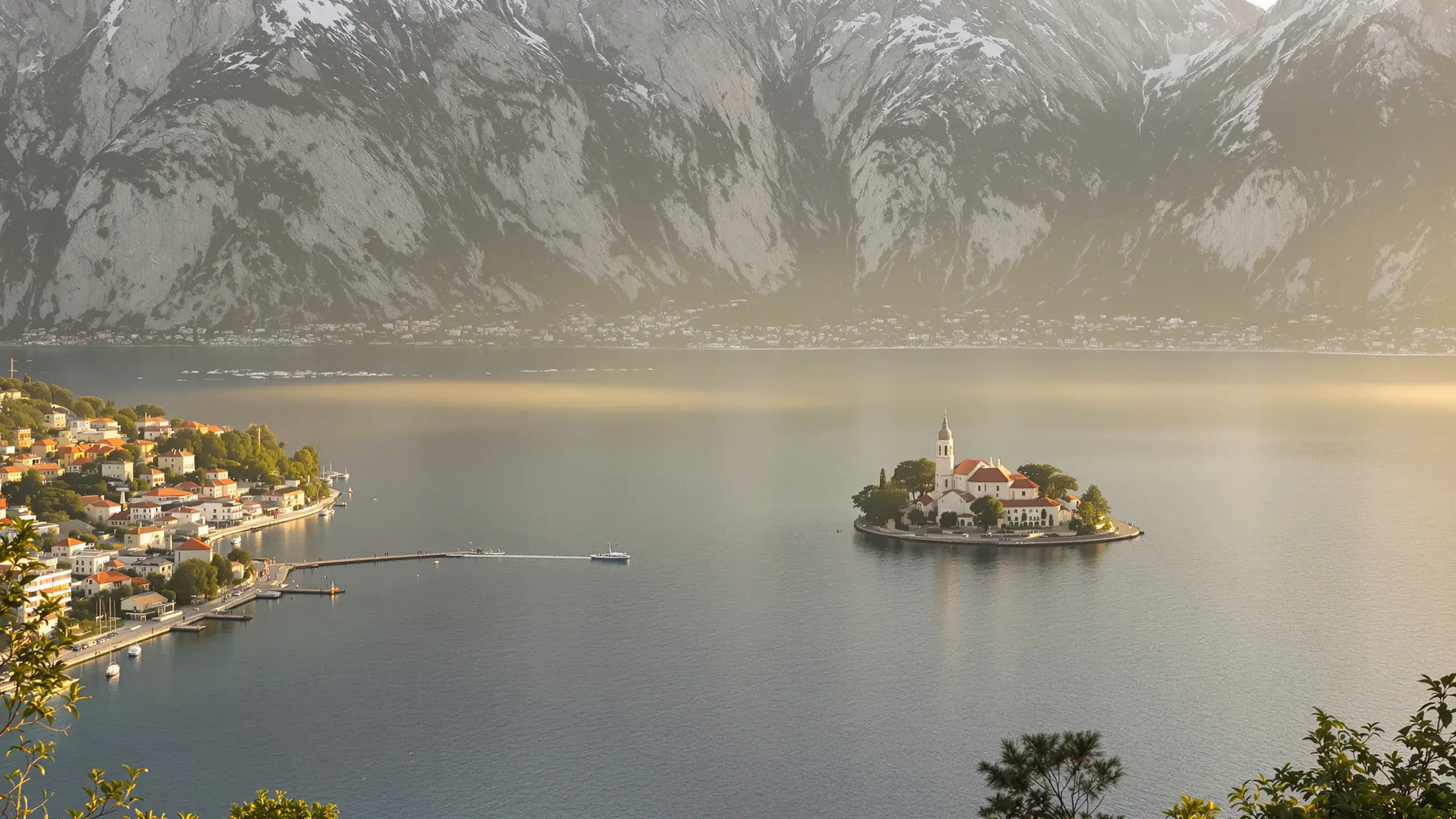
🇲🇪 Montenegro Digital Nomad Visa: Your Dream Life on the Adriatic, Up to Four Years
Imagine calling Montenegro home: the Adriatic, breathtaking mountains and low living costs, all in one small country. Its digital nomad permit runs up to four years, and the foreign remote income it rests on is exempt from Montenegrin income tax. More freedom. More possibility. Your life, reimagined.
At a glance
| Duration | Up to 2 years, extendable once by up to 2 years (max 4) |
|---|---|
| New application | No earlier than 6 months after the old permit expires |
| Income threshold | 3 Montenegrin minimum wages a month (previous year), €1,800-2,400 depending on the reading |
| Where to apply | In person at the Ministry of the Interior (MUP) at your planned place of residence; visa-required nationals need a visa D first |
| Processing | Decision within 40 days of a complete application |
| Fees | Low admin fees, no official fee schedule; translations cost more |
| Tax | Remote income from foreign employers exempt from income tax (Sl. list CG 152/22) |
| Permanent residence | Not via this permit: 5 uninterrupted years needed, max 4 plus a 6-month break |
The Montenegro digital nomad visa in brief
Your morning starts with a swim in the Bay of Kotor. By noon, you’re working with a mountain view. Come evening, dinner by the water costs half what you’d pay in Lisbon or Split. That’s the life Montenegro offers.
But before you fall in love: Montenegro is an EU candidate, not a member, so EU free movement does not apply. To stay longer than your visa-free days and work remotely, you need a residence permit, even if you’re an EU citizen. The digital nomad permit exists for exactly that.
This isn’t just a dream; it has a legal foundation. In 2022, Montenegro made room for digital nomads through an amendment to the Foreigners Act (Zakon o strancima, Sl. list CG 86/22), introducing the temporary residence permit for digital nomads. Permits have been issued since 2023, supported by a government program to attract digital nomads and the official portal digitalnomads.gov.me. The new Foreigners Act in force since January 2026 (Sl. list CG 3/2026) continues the category.
Your permit. Your next chapter.
| Point | Rule |
|---|---|
| Duration | Up to 2 years |
| Extension | Once by up to 2 more years, 4 years at most |
| New application | No earlier than 6 months after the old permit expires |
| Minimum income | 3 Montenegrin minimum wages a month, currently €1,800-2,400 depending on the reading |
| Allowed work | Only electronic work for employers or your own company outside Montenegro |
| Where to apply | In person at the Ministry of the Interior (MUP) where you plan to live |
| Processing | Decision within 40 days of a complete application |
| Tax | Remote income from foreign employers exempt from income tax |
Imagine making Montenegro your home, without leaving your international career behind. You qualify as a digital nomad if you work fully electronically for a company not based in Montenegro, as an employee, on a contract basis or through your own company registered abroad. Working for Montenegrin firms or local clients is not allowed. You stay outside the local labor market, and in return, you need no work permit.
Income: three minimum wages, but which ones?
Ready to make Montenegro your home? Don’t let an unclear income requirement derail your plans. Like Slovenia, Montenegro did not set a fixed euro threshold. The implementing regulation under the Foreigners Act requires proof of monthly income of at least 3 Montenegrin minimum wages, for the year before you apply. Here’s the catch: since October 2024, the minimum wage has two tiers, €600 in general and €800 with a university degree. Depending on the reading, that means €1,800 or €2,400 a month. The authorities publish no fixed euro figure, and every minimum wage increase shifts the threshold. Give yourself breathing room: plan for €2,400 plus a buffer.
Turn your plans into a well-prepared application. In practice, you prove your income with employment or client contracts plus bank statements showing regular payments over the previous year. You’ll also need a passport valid at least 3 months beyond the requested stay, proof of accommodation in Montenegro, a criminal record certificate without relevant convictions, and health insurance for the whole stay. Want greater peace of mind? Our overview of health insurance for digital nomads explains what a solid international policy needs.
How to apply: take the first step towards your Montenegro life
That Montenegro life you keep imagining? This is where you start making it real. If your passport lets you enter Montenegro visa-free, your first step is refreshingly simple: enter normally, then apply in person at the Ministry of the Interior (MUP) office for your planned place of residence, within your visa-free days. Need a visa for Montenegro? First, apply for a long-stay visa D at a Montenegrin mission. Either way, the residence permit itself is issued in the country.
- Bring your new beginning within reach: gather your passport, proof of remote work for a foreign employer or your own foreign company, income proof for the previous year, insurance policy, accommodation proof, criminal record certificate. Foreign-language documents need certified translations into Montenegrin.
- Turn “one day” into action: apply in person at the MUP where you live, with biometrics for the residence card. Here’s a welcome relief: administrative fees are low (applicants consistently report amounts under €100), but there is no official fee schedule; most of your budget goes on translations and certifications.
- Start looking towards your next chapter: the law provides for a decision within 40 days of a complete application.
And you don’t have to imagine that next chapter without the people you love. Family reunification is possible: your spouse and minor children can apply for their own permits, and since the new Foreigners Act this expressly includes same-sex partners. The funds you show must cover the whole family.
Does the program really end in 2026?
Worried you’re about to miss your chance? For months, relocation sites have quoted a fixed end date, usually 31 December 2026, often urging you to book quickly. But check the primary sources, and you can breathe easier: neither the new Foreigners Act in force since January 2026, which continues the nomad permit without a time limit, nor the tax exemption in the income tax law contains an expiry date. What expired was the government's strategy paper, the program to attract digital nomads planned until 2025. That was a plan of measures and marketing, never the permit’s legal basis.
Still, your next chapter deserves clarity, not empty promises. Montenegro is visibly reworking its foreigners law. The new act has already tightened other categories, such as property-based residence, and more adjustments will come on the road to the EU. As of August 2026, there is no statutory countdown, but no guarantee that terms will stay unchanged either. Here’s what matters: a permit once granted runs on the terms it was granted on.
Taxes: the real reason this program stands out
Imagine keeping more of the income you already work so hard to earn. With the tax amendment of December 2022 (Sl. list CG 152/22), Montenegro wrote an explicit exemption into its income tax law: for holders of the nomad status, income from employment or self-employment for an employer not registered in Montenegro stays free of income tax. That means the very income you use to qualify for the permit is not taxed by Montenegro. Unlike Slovenia or Spain, and like Croatia, Montenegro exempts this income, but it gives you up to 4 years instead of 18 months.
That freedom matters, but so does knowing exactly where it ends. The exemption is not a free pass for your whole financial life. Spend more than 183 days a year in Montenegro or have your center of vital interests there, and you become tax resident. Only your foreign remote income is exempt. Other income, such as capital income or local earnings, falls under the regular Montenegrin system, with moderate progressive rates of 9% and 15%.
Before you make the leap, remember: your home country's rules decide whether you remain taxable there. If you are a US citizen, you remain subject to US income tax on your worldwide income wherever you live (IRS).
Permanent residence: know the limits before you fall in love
Dreaming of making Montenegro your forever home? Permanent residence requires 5 years of uninterrupted legal residence. The nomad permit gives you 4 years at most, followed by a mandatory 6-month break before a new application, so this route never reaches 5 years in a row. To settle on the Adriatic for good, you will need to switch to another category, such as local employment, your own company in Montenegro or property ownership, each with its own, recently tightened requirements. But for one to four tax-efficient years? The nomad permit is exactly the right tool to turn that dream into your everyday life.
Who Montenegro suits
Croatia too short? Serbia too far from the sea? Montenegro could be the freedom you’ve been craving: up to 4 years, remote income without Montenegrin income tax, the euro as currency and living costs well below EU coastal levels, with direct flights to Podgorica and Tivat. Picture your life by the bays from Kotor to Budva, where infrastructure is concentrated. Just know: the coast goes quiet in winter, and paperwork takes patience and translations. Explore life there in our Montenegro country profile. Weigh the neighbors: the Croatia digital nomad visa also exempts remote income, but for 18 months only, while the Serbia program offers an online application and a real path to permanent residence. Find your next chapter in the overview of all digital nomad visas.
Frequently asked questions
How long can I stay on the Montenegro digital nomad visa?
Imagine making Montenegro your home for up to 2 years, and extending your stay once by up to 2 more years. That’s 4 years at most to live the life you’ve dreamed of. Ready to return? A new application is possible only 6 months after the old permit expires.
How much income do I need?
Make your move with confidence: you need at least 3 Montenegrin minimum wages a month for the previous year. With the two-tier minimum wage, that means €1,800 or €2,400 a month; for peace of mind, plan for €2,400 plus a buffer.
Is the program ending in December 2026?
Breathe easy: no end date appears in the law. The new Foreigners Act of January 2026 continues the permit, and the tax exemption has no expiry date. Only the government strategy to 2025 expired, not the permit or the tax exemption.
Do I pay tax in Montenegro on my remote income?
Keep more of what you earn. While you hold the nomad status, you pay no Montenegrin income tax on income from employers or your own company outside Montenegro. Other income is taxed at 9% and 15%.
Could Montenegro be your Adriatic base?
Your Adriatic dream deserves a clear plan. We explore whether the nomad permit fits your situation, how to prepare your file for the MUP, and what the tax exemption means alongside your obligations at home.
Book a consultation