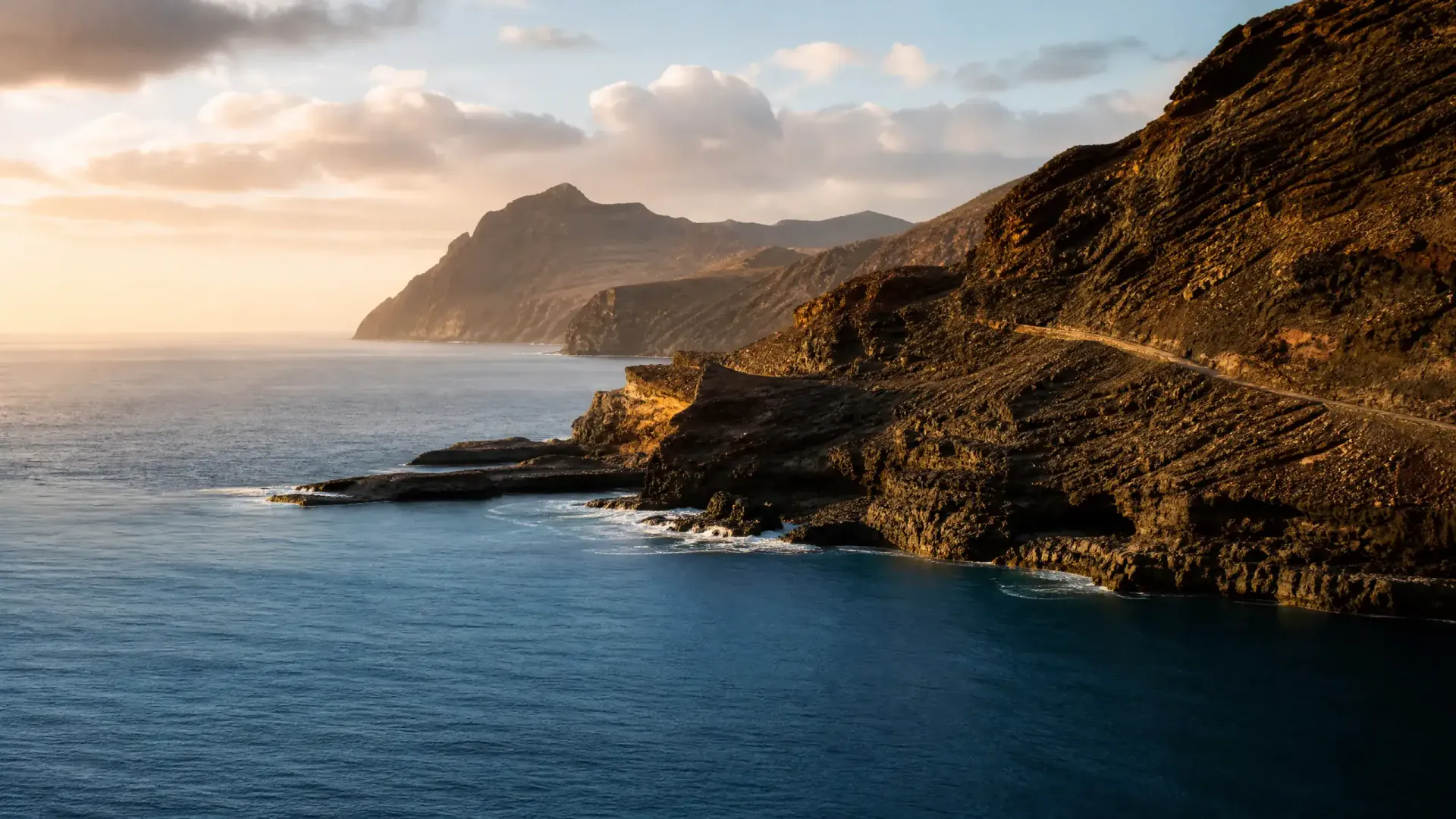
🇨🇻 Live Your Digital Nomad Dream in Cape Verde: Sun in January, Close to Europe
Imagine trading grey skies for Cape Verde’s warm, dry weather all year, with a time zone close to Europe and one of the simplest remote working programs anywhere. Tempted? Go in with your eyes open: thin infrastructure, weak medical care and a very small scene are the tradeoffs.
At a glance
| Monthly costs | €1,500-2,000 on Sal or Boa Vista; €1,200-1,600 in Mindelo or Praia |
|---|---|
| Internet | Fiber up to about 100 Mbit in the main towns (€30-70 a month); Starlink since December 2024 |
| Time zone | UTC-1 |
| Best season | November to June |
| Visa route | Remote Working Cabo Verde Programme: 6 months, renewable once for 6 months |
| Proof of funds | Average balance of at least €1,500 over the last 6 months (about €2,700 for families) |
| Tax on foreign income | Not taxed locally under the program; residents (over 183 days) taxed on worldwide income |
Why a digital nomad picks Cape Verde
Imagine swapping winter gloom for sea views and sunshine. Cape Verde answers one irresistible question: where can you work by the sea at 27°C in January, a short flight from Europe and with hardly any time difference to it?
About 600 kilometers off the coast of West Africa, this archipelago offers warmth you can count on: a warm, very dry climate all year, little rain and only a few degrees of difference between seasons.
And the appeal goes deeper than sunshine. Cape Verde stands out in Africa for decades of political stability and democratic continuity, very low crime and a state that makes up for its small size with reliability. It was also one of the first African countries to launch its own program for remote workers.
The catch? It is small. Very small. And its thin infrastructure is a real trade-off.
Everyday life
In Cape Verde, life slows down, and invites you to finally exhale. If you expect things to happen at the agreed time, you will need to adjust.
Portugal’s influence lives on in the language, colonial architecture, administration and coffee. Yet the islands’ heart is West African and Creole, with a world-renowned musical tradition woven into everyday life.
Here, you live outdoors and know half the neighborhood after two weeks. Sal and Boa Vista cater heavily to tourism, while São Vicente and Santiago offer a far more authentic feel. Keep cash handy; it matters, although cards work in the tourist areas.
Choosing your island
This is the decision that shapes your entire experience: ten islands, each fundamentally different.
Sal, and specifically the town of Santa Maria, is the obvious choice for remote workers: flat, sandy and sunny all year, with the main international airport, the best infrastructure, coworking, restaurants and an international community. Imagine finishing work and heading out to a world-class spot for kitesurfing and windsurfing. The trade-off? A touristy feel and bare landscape.
Boa Vista offers a similar escape, quieter than Sal, with wonderfully long beaches and coworking in Sal Rei, but thinner infrastructure.
São Vicente and its capital Mindelo are where the archipelago’s cultural heart beats: a real small city with a harbor, colonial buildings, a music scene and daily life that does not depend on tourism. Want to feel part of a town, not a resort? Mindelo is the right choice.
Santiago and the capital Praia are the administrative and economic center: choose them for the best internet, but expect the least charm.
Santo Antão, an hour by ferry from São Vicente, draws you into green valleys, terraced farming and hiking trails along a volcanic coast. No airport, little infrastructure, but the most beautiful island. Fogo delivers its own extraordinary sight: an active volcano and vineyards in its crater.
Internet and power
Your island dream doesn’t have to mean disconnecting: Cape Verde is connected by international submarine cables, and the government has invested in infrastructure through its digital hub project. Fiber is available in the main towns of Praia, Mindelo and Santa Maria, with plans of up to about 100 Mbit. Good connections usually measure 20-100 Mbit, while the national fixed-line median is only in the low double digits. Stay connected for €30-70 a month. Mobile 4G is good in populated areas, 5G only in spots.
Starlink has been available in Cape Verde since December 2024, largely solving the old connectivity problem of the remote islands, and bringing those once-distant island possibilities thrillingly within reach.
Don’t let a preventable surprise steal your peace of mind: old, slow copper lines are still around. Ask for a speed test screenshot before every booking. Power cuts happen, so a power bank for the router and a mobile data plan as backup are essentials.
Make your island workday a reality in Santa Maria, Sal Rei, Mindelo and Praia: coworking day passes start from €8-15, with monthly prices of €90-180. Most spaces run fiber with mobile backup.
Food
Taste Cape Verde at its most authentic: simple food, influenced by Portugal, with the sea at its heart. Fish and seafood are excellent and cheap: tuna, wahoo, grouper and lobster straight from the Atlantic. Don’t miss the national dish, cachupa, a comforting stew of corn, beans and whatever is at hand.
Eat locally and make your money go further: a meal in a simple restaurant costs €6-12. Tourist restaurants on Sal cost considerably more.
The catch: almost everything except fish is imported, so supermarket prices are high and choice is limited. Fresh fruit and vegetables are expensive, except on the green islands of Santo Antão and Fogo. Craving international cuisine? It barely exists outside the hotels.
People and community
Feel the warmth of Cape Verdeans: friendly, relaxed and musical. In Mindelo, live music fills practically every night, not a show staged for tourists, but the heartbeat of everyday life.
Language can open doors, or leave you feeling lost. Portuguese is the official language and Creole the everyday one. With Portuguese, you get by everywhere. In the tourist areas of Sal and Boa Vista, you’ll hear English, Italian and some German. Outside them, life gets difficult without Portuguese.
The international community is small: a modest remote-work presence on Sal and in Mindelo, alongside established European residents, mostly Portuguese, Italian and French. Looking for connection? You’ll find a handful of people, not a scene. Think small circles, not big crowds.
One reality you shouldn’t overlook: arriving remote workers have pushed up housing prices on Sal. The government is openly discussing how to balance this with the interests of local residents.
Your Investment
| Item | Sal / Boa Vista | Mindelo / Praia |
|---|---|---|
| Furnished one-bedroom, monthly rent | €700-1,200 | €450-850 |
| Groceries (mostly imported) | €250-350 | €220-320 |
| Eating out | €6-12 per meal | €5-10 per meal |
| Coworking, monthly | €90-180 | €80-150 |
| Coworking, day pass | €8-15 | €8-15 |
| SIM with data | €15-25 | €15-25 |
| Domestic flight between islands | €40-110 | €40-110 |
Picture your life in Cape Verde: realistically, you spend €1,500-2,000 a month on Sal or Boa Vista and €1,200-1,600 in Mindelo or Praia. Housing and imported goods drive the cost, but your money can go further. Want to live frugally? Choose Mindelo and eat locally.
Enjoy the peace of mind of knowing the Cape Verdean escudo is pegged to the euro, removing currency risk for anyone earning in euros and making your new life much easier to plan.
Health and safety
Your health is too important to leave to chance, and medical care is the clear weakness here. There are hospitals in Praia and Mindelo and clinics on Sal, but depth of care is missing. For serious cases, the standard route is evacuation to Portugal, Senegal or the Canary Islands.
Protect yourself before you go: your insurance must include medical evacuation. In Cape Verde, that is not optional, it is the main reason for the policy. Find out what matters on our page on health insurance for digital nomads. If you have a chronic condition or need regular specialist care, Cape Verde is not a good long-term base.
The reassuring part? Safety is a strong point. Cape Verde is one of the safest countries in Africa, with political stability, working institutions and low violent crime. Still, stay alert: pickpocketing happens in tourist areas and in Praia. And respect the Atlantic: currents are strong at many beaches, and lifeguards are rare.
Climate
Imagine year-round warmth and wonderfully dry days, with temperatures between 22°C and 30°C and little variation. Rain rarely interrupts your plans, falling mostly within a few weeks between August and October.
From November to June, the weather is a dream: sunshine, warmth and a steady trade wind that keeps the heat comfortable, and makes the islands an irresistible destination for windsurfing and kitesurfing.
August to October is more humid, and the harmattan can bring Saharan dust over the islands, reducing visibility and air quality for days. But for a winter escape within easy reach of Europe, Cape Verde is one of the best bases you could choose.
Getting there and the time zone
Your island escape is closer than you think. Sal and Boa Vista have direct flights from several European cities, busiest from autumn to spring, with flight times of around five to six hours from Central Europe. São Vicente has direct links to Lisbon, Paris and Amsterdam, among others, and the islands are well connected via Lisbon all year. Ready to explore? Fly between islands with the national airline (€40-110) or take the ferry, most importantly between São Vicente and Santo Antão.
Cape Verde is on UTC-1. Leave the winter behind, not your clients. For clients in Europe your working day overlaps almost completely with theirs: no jet lag, no night shifts. Together with Morocco and South Africa, it is one of the few winter destinations that cost you nothing in working hours if your clients are in Europe. Your work stays on track. Your life gets an island backdrop.
Entry and the remote working program
Your Cape Verde escape is calling, and your passport holds the key. It determines whether you can visit without a visa, and for how long. If you can, you still need to register online on the government's EASE platform before departure and pay the airport fee. Skip pre-registration and you can do it on arrival at double the rate, but you risk trouble at check-in. Protect that holiday excitement: take care of this before you go.
What if you didn’t have to leave so soon? The Remote Working Cabo Verde Programme could turn your dream escape into everyday life. One of the first of its kind in Africa, it has, since May 2025, been formally regulated as a residence visa by Decree-Law 13/2025. Here’s your path to staying longer:
- Six months, renewable once for six months, giving you up to a year in total to make Cape Verde feel like home. After that, you need a regular residence permit.
- Proof of funds: an average bank balance of at least €1,500 over the last six months for individuals, about €2,700 for families. Your balance opens the door, not monthly income.
- Open to nationals of Europe, North America, the Portuguese-speaking countries and the West African economic community (ECOWAS). Could this be your opportunity?
- Bring proof of self-employment or of work that can be done remotely, plus health insurance valid in Cape Verde, and move closer to the life you’re imagining.
- Two steps: online pre-registration, then the stamp on arrival. Straightforward processing and a low rejection rate give you less to worry about, and more to look forward to.
- Bring your family and enjoy the freedom of no minimum-stay requirement. Just remember: work for Cape Verdean companies is not allowed.
That next chapter doesn’t have to stay a daydream. It is one of the simplest programs anywhere. Discover the fees and steps on our Cape Verde digital nomad visa page, and take your first step towards it.
Tax in Cape Verde
Your island dream is within reach; make sure tax surprises don’t spoil it. Cape Verde taxes residents on their worldwide income at progressive rates. You generally become resident if you spend more than 183 days a year in the country or keep a home there with the intention of staying.
Now for the news remote working visa holders want to hear: in practice, foreign income is not taxed locally under the program, and for a typical stay no Cape Verdean tax arises on foreign income.
Keep that feeling of freedom by planning ahead. Spend the full twelve months in the country, and you are well past the 183-day mark, so have your situation checked. Cape Verde has a small treaty network, mostly with Portuguese-speaking countries: check the position for your home country before committing to a longer plan. Before you take that next exciting step, explore the tax guide to Cape Verde for the regimes for longer-term residents.
Cape Verde is not a good choice of new tax residence for tax planning: fall in love with the island, not a tax-saving illusion. It taxes residents on worldwide income, its treaty network is thin and the remote working visa ends after twelve months.
Your tax at home
Dreaming of a seasonal escape to Cape Verde? For almost every reader, that’s exactly what it is, not a change of residence. Don’t let leaving home give you false peace of mind: your tax residence does not end automatically, and whether you remain taxable at home depends on your home country's own rules.
If you are a US citizen, you remain subject to US income tax on your worldwide income wherever you live (IRS). Get clarity before you go: our guide on where digital nomads pay taxes explains how home country, host country and treaties fit together.
Is Cape Verde right for you?
Craving a winter base without sacrificing your time zone or facing a long-haul flight from Europe? Cape Verde could be your escape: warmth on your skin, wind in your hair and water calling you outside, if you’re happy with limited choice. For two to four months of quiet, focused work, Mindelo is a wonderful fit.
But don’t ignore what you need to feel at home. If you depend on good medical care, crave a lively community or varied food, or want a country that works beyond one season, it’s less suited to you. Cape Verde is a great place for three months and a very small place for three years.
Want that same time zone advantage, but more room to explore? Look at Morocco. Dreaming of island life with better infrastructure and low taxation? Consider Mauritius, but be ready for a much longer flight.
Frequently asked questions
Does Cape Verde have a digital nomad visa?
Yes, your island escape could be closer than you think. The Remote Working Cabo Verde Programme grants six months, renewable once for six months. Show an average bank balance of at least €1,500 over the last six months (about €2,700 for families), register online first and get the stamp on arrival. Your next chapter starts here.
How much does it cost to live in Cape Verde as a digital nomad?
Your Cape Verde dream has a realistic price tag: €1,500-2,000 a month on Sal or Boa Vista and €1,200-1,600 in Mindelo or Praia. Housing and imported groceries take the biggest bite, but eating locally helps keep that dream affordable.
Is the internet in Cape Verde good enough for remote work?
Yes, in the main towns, your work-from-paradise dream is within reach: fiber of up to about 100 Mbit costs €30-70 a month, and Starlink has been available since December 2024. Don’t let slow copper lines spoil it; they still exist. Ask for a speed test before booking and keep mobile data as a backup for extra peace of mind.
Do I pay tax in Cape Verde as a remote worker?
For a typical stay, no. Keep more of what you earn! Foreign income is not taxed locally under the program. But plan with confidence: residents, generally those staying more than 183 days a year, are taxed on worldwide income. Staying the full twelve months? Have your situation checked for peace of mind.
Planning a season in Cape Verde?
Before you fly, feel confident about your tax residence
Cape Verde is an easy winter base but not a tax residence. Leave the guesswork behind: we help you check how a season on the islands fits your current residence, and what to settle at home before you go.
Book a consultation