🇺🇾 Uruguay for digital nomads: Find your freedom in Latin America's safest base
Ready to feel secure, and finally make your move? Uruguay is the safest and most stable country in Latin America, with a nomad permit that has no income threshold. But its tax reform of 1 January 2026 changed who benefits from moving there, and how.
At a glance
| Monthly budget | Montevideo €1,700-2,600 |
|---|---|
| Internet | Fiber 100-700 Mbps for 1,500-3,500 pesos a month |
| Time zone | UTC-3, no daylight saving time |
| Best season | December-March |
| Visa route | Nomad permit: 180 days, renewable once, no minimum income |
| Tax on foreign income | Earned income from work done in Uruguay taxable up to 36%; 12% on foreign capital income outside the 11-year holiday |
Uruguay for digital nomads in brief
For years, Uruguay was the best-kept secret for anyone longing for a secure foothold in Latin America: political stability, a reliable rule of law, good banking, and one extraordinary reward, an eleven-year exemption on foreign capital income for new residents, in return for a property investment of about US$590,000 and some sixty days a year in the country.
On 1 January 2026, budget law Ley 20.446 changed that. That investment still makes you tax resident, but the tax holiday is no longer yours with it. Now, securing the holiday takes real presence or far larger sums. The permanent 7% option is closed to newcomers, and the 12% tax on foreign capital income reaches further.
Already in? Everything you secured stays yours. And the reason Uruguay captures your heart remains: the safest, most stable and most pleasant country in Latin America.
Everyday life
Imagine a life that lets you exhale. That is Uruguay: calm from your first impression, and long after. Three million people live in an area about the size of England, almost half of them in Montevideo.
A functioning welfare state. A long democratic tradition. An unusually strong rule of law. A society that is egalitarian by regional standards. These are foundations you can build a life on. The mate cup under the arm? Not a cliché, but the national signature, with a thermos as standard equipment.
The trade-off? Uruguay is slow. Authorities, tradespeople, deliveries: expect to wait. And it is expensive for Latin America, because wages are higher and import duties bite. Peaceful does not mean perfect, or cheap.
Where to base yourself
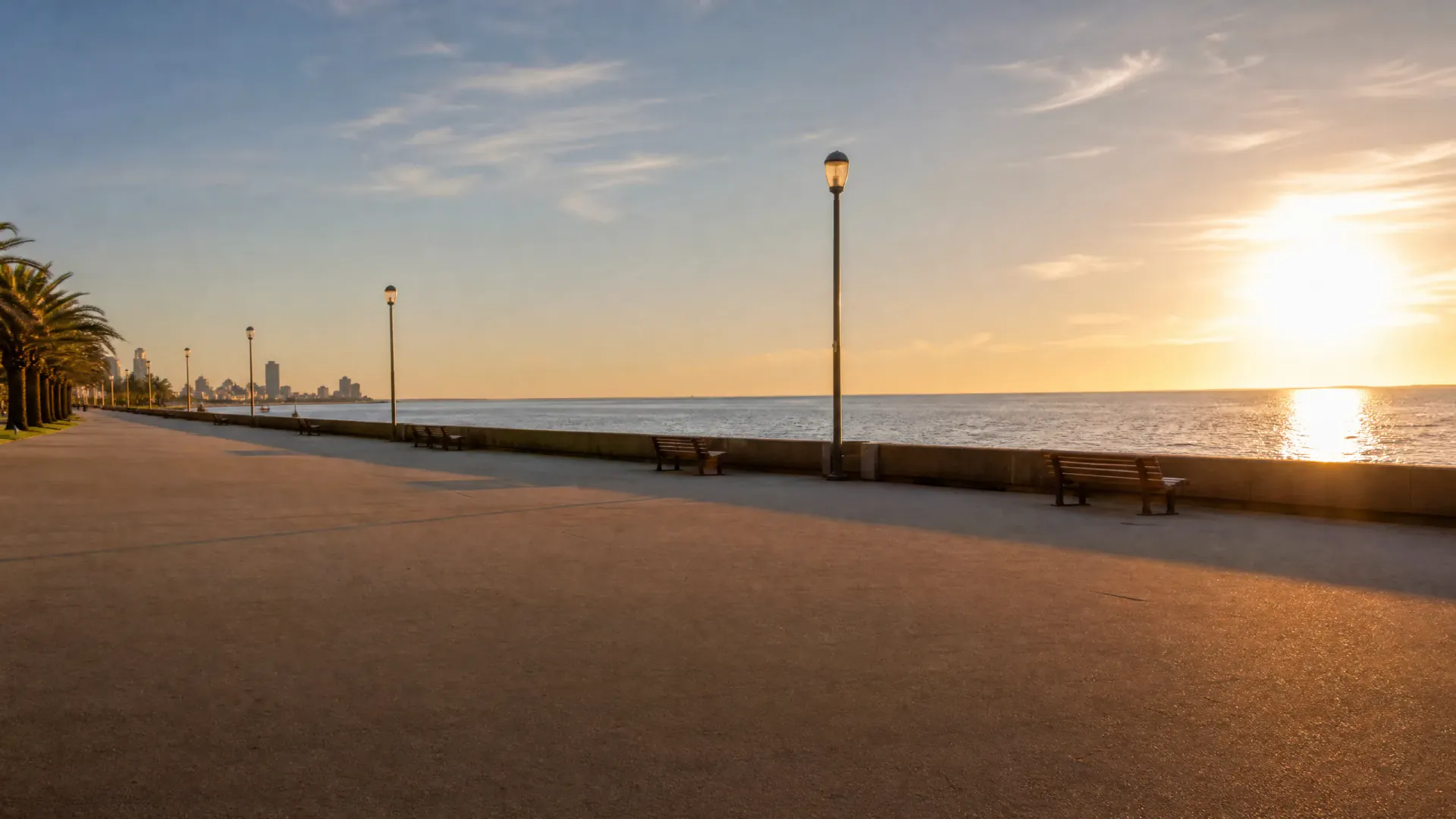
Montevideo is where your city-life dreams come alive. Pocitos brings waterfront comfort: a promenade, cafes and apartment towers. Craving quiet, upscale living? Choose Punta Carretas. Drawn to history and change? Discover Ciudad Vieja, the historic old town in transition. Cordón and Parque Rodó offer a younger, cheaper scene. But Montevideo's real luxury is The Rambla: a continuous waterfront promenade of more than twenty kilometers, where you can run, cycle or simply sit by the water and breathe.
Punta del Este is the famous resort that draws Argentine and Brazilian holidaymakers in summer, then stands largely empty in winter: pretty, expensive, seasonal. Want somewhere smaller and more exclusive? Explore José Ignacio and La Barra. Colonia del Sacramento, a colonial town on the Río de la Plata, puts Buenos Aires an hour away by ferry, ideal for a life between the two countries. Craving rural space without the high cost? Inland Canelones and Maldonado are wide open and cheap.
Internet and work
Uruguay gives you something priceless: confidence in your connection. It has one of the highest fiber penetration rates in Latin America, run by the state provider ANTEL, with good coverage outside the capital too. Get 100-700 Mbps for 1,500-3,500 pesos a month, roughly €33-78: expensive by regional standards, but leading in quality. Add good mobile coverage and rare power cuts, and breathe a little easier.
Find your working rhythm in Montevideo, with a decent choice of coworking spaces offering a fixed desk for 8,000-18,000 pesos a month. The scene is small, but the tech sector is established: Uruguay is a major software exporter, while free zones such as Zonamerica serve international companies.
Food and wine
Love Argentina's beef culture? Uruguay brings you every bit of that mouthwatering pleasure. The asado is the central social institution, where people come together over exceptional meat from cattle that graze outdoors all year. Gather around the parrilla for asado de tira and morcilla, savour everyday Italian and Spanish cooking, and bite into the chivito, the national sandwich. Uruguayan wine deserves far more love, especially Tannat: discover it at the wineries around Canelones, an hour from Montevideo.
Go with your eyes open: prices are the highest in Latin America. Dinner in a good Montevideo restaurant costs almost as much as in southern Europe, and supermarkets are noticeably pricier than in Argentina or Brazil. Craving variety? Here’s the drawback: little international food and hardly any Asian cuisine.
People and community
Uruguayans are more reserved than Argentines or Brazilians: friendly, reliable and low-key, a manner some find cool and others genuinely pleasant. You need Spanish. English is spoken in Montevideo's tech sector and upscale services, and little elsewhere. Society is unusually homogeneous, mostly of Spanish and Italian descent.
The international community is small. A growing number of wealthy arrivals, especially from Argentina and Brazil, choose Uruguay as their safe harbor, alongside a few freelancers. Looking for a ready-made nomad scene? In the usual sense, it simply does not exist.
Here’s the honest truth: Uruguay is calm to the point of boredom. Crave urban friction, nightlife and constant novelty? This is the wrong place. But if you’re longing for peace, safety and reliability, Latin America has nothing better, and Buenos Aires is just a ferry ride away.
The price of possibility
| Item (per month) | Montevideo | Coast, off-season |
|---|---|---|
| Furnished studio, Pocitos | €700-1,100 | €500-850 |
| One-bedroom apartment with a view | €900-1,600 | €700-1,300 |
| Groceries and eating out | €500-850 | €450-750 |
| Coworking, fixed desk | €170-380 | €130-280 |
| Fiber internet | €33-78 | €33-78 |
| Transport | €60-150 | €100-250 |
| Private health plan (mutualista) | €60-160 | €60-160 |
Realistically you spend €1,700-2,600 a month in Montevideo. Uruguay is the most expensive country in Latin America: Portuguese or Spanish prices, with fewer options. So why choose it? Because the real draw isn’t a bargain. It’s the peace of mind that comes with stability. That’s what people are willing to pay for.
And banking? It’s a compelling reason in its own right. Excellent by regional standards, Uruguay has long been the region’s reliable financial center. Accounts in US dollars and euros are common, and foreigners with residence can expect orderly access, a reassuring foundation for your new life.
Safety, health and climate
Uruguay is the safest country in Latin America, by a wide margin over Brazil, Colombia or Mexico. Imagine the relief of feeling more secure. In Montevideo, normal city awareness still matters: avoid certain outer districts and watch for pickpocketing. Violent crime against foreigners is rare.
Good health care means precious peace of mind. The mutualistas, private health associations with a monthly fee, welcome newcomers with affordable, reliable care. And when complex cases need attention, Buenos Aires and São Paulo are within reach.
Enjoy a temperate climate with four real seasons, reversed from the northern hemisphere. Summer from December to March is the best time, with 25-30°C days and refreshing sea breezes on the coast. Winter from June to August is mild but damp and windy, at 8-15°C. Be prepared: poorly insulated houses, rarely well heated, feel colder indoors than the thermometer suggests. That discomfort is the main complaint of newcomers.
Getting there and time zone
Your Montevideo adventure is closer than it feels. Long-haul nonstop routes are few, with most trips connecting via Madrid, São Paulo, Panama City or Buenos Aires. And with Buenos Aires just one to three hours away by ferry across the Río de la Plata, pairing Montevideo with Argentina feels wonderfully easy.
Uruguay is on UTC-3 and has no daylight saving time. Stay connected without missing out: your morning overlaps with Europe's afternoon, and you share most of the working day with the US East Coast. Enjoy the same comfortable position as Brazil and Argentina.
Entry and residence
Your next chapter starts with your passport’s normal entry rules: visa-free or with a tourist visa, depending on your nationality.
Since 2023 Uruguay has offered a nomad permit that lets you stay for 180 days, renewable once, with a fully online application through the official procedure and with no minimum income. It’s one of the most accessible programs anywhere: your chance to experience life here without committing to a permanent move. Explore the Uruguay digital nomad visa page.
Ready to put down roots? The residencia legal, available through proof of income or investment, offers a permanent move and can lead to citizenship after several years. Uruguay is one of the few countries in the region where that dream has a realistic, orderly path.
Keep residence and tax residence apart. Your plans deserve clarity: each is applied for and checked separately, and the 2026 reform targets exactly the tax side.
The 2026 tax reform
Until the end of 2025: Uruguay’s territorial tax system offered a powerful advantage: foreign income was in principle not taxed. Residents have paid 12% on foreign dividends and interest since 2011, while foreign capital gains and rents held through non-resident companies stayed untaxed. For new residents, the choice was compelling: an eleven-year exemption or a permanent 7% rate.
What Ley 20.446 changed from 1 January 2026, and why your next move matters:
- The investment route of about US$590,000 (3.5 million UI) with at least 60 days of presence still makes you tax resident, but no longer unlocks the tax holiday. It remains in force under Decreto 148/007, art. 5-BIS. Don’t confuse residency with tax relief.
- The holiday is still within reach for new residents, but the requirements matter: more than 183 days of physical presence with no investment, real estate above 12.5 million UI, about US$2 million, or at least 625,000 UI a year, about US$100,000, into designated innovation and productive funds for the term of the holiday.
- The permanent 7% option is closed to new residents. That door has shut.
- The standard rate on foreign capital income is 12%, now also covering foreign capital gains and rents. Your exposure has changed.
- A new transparency regime attributes the income of non-resident companies to their Uruguay-resident individual shareholders. Don’t assume a foreign company in between protects you: it no longer automatically keeps income out of Uruguay's tax net.
- Grandfathering: if you obtained and elected the benefit before 2026, you keep it on the original terms for its full remaining term. That protection is explicit in the law, not just a reassuring promise.
- Withholding and advance payments for the first half of 2026 started in July 2026. Planning matters.
What this means for digital nomads
If you are a remote worker living on fees or salary: don’t let the 12% headline fool you. It applies to foreign capital income (dividends, interest, rents, capital gains), not to foreign earned income from remote work.
Here’s the trap you cannot afford to miss: income for work you physically perform in Uruguay counts as Uruguayan-source, even if your client and your bank account are abroad. As a tax resident, you then pay progressive IRPF of up to 36%. Days you work outside Uruguay are not covered. For capital income, Uruguay has real appeal. For a remote worker earning income while physically there, the picture is far less attractive.
If you live on capital income: Uruguay still deserves your attention on the new terms. For most, the realistic route is more than 183 days of presence, with no investment needed. Eleven years of exemption on foreign capital income is an opportunity worth taking seriously, and the 12% afterwards is moderate internationally. If you are already in the old regime, your protected position has just become more valuable.
Another powerful advantage: Uruguay levies a wealth tax only on assets located in the country above an exemption of about US$163,000; foreign assets are exempt, unlike in Argentina, which taxes worldwide assets.
Your tax position at home
Don’t let your dream move to Uruguay turn into a painful tax shock. Moving does not automatically end your tax residence at home; your home country's rules decide. US citizens remain subject to US income tax on their worldwide income wherever they live (IRS). Uruguay has expanded its treaty network in recent years, but your position depends on your home country, so check yours before planning. Protect your fresh start with Where digital nomads pay taxes, which explains how home country, host country and treaties interact.
Here’s a structural advantage you can feel genuinely reassured by: Uruguay is legally reliable, transparently regulated and internationally unremarkable. A Uruguayan residence does not look artificial to a home tax authority, and when an audit comes, that credibility matters most. Build your next chapter on that peace of mind.
Is Uruguay right for you?
What is peace of mind worth to you? If safety, rule of law and stability matter more than buzz and price, Uruguay deserves a serious look. It suits wealthy people living mainly on capital income who are ready to truly live there or invest heavily, and anyone who needs the reassurance of a residence that will stand up to an audit.
But don’t gamble on the wrong fit. If you earn from ongoing work done while you’re in the country, have a limited budget, or crave city energy, Uruguay may leave you disappointed.
Craving buzz and lower prices? Argentina is a ferry ride away, but the trade-off is instability and a wealth tax. Want clear territorial taxation without minimum-presence requirements? Explore Panama. Compare the low-tax bases on tax residence for traders. Your future is too important to leave to chance: run the reform against your own situation before you move, not after.
Frequently asked questions
Is Uruguay good for digital nomads?
Want freedom without sacrificing peace of mind? Yes: Uruguay is the safest and most stable country in Latin America, with fast fiber and UTC-3 without daylight saving. But budget carefully: Montevideo is expensive (€1,700-2,600 a month), and once you are tax resident, work you physically do there counts as Uruguayan-source income.
Do digital nomads pay tax in Uruguay?
Don’t let unexpected taxes derail your Uruguay dream. Become tax resident, and work you physically perform in Uruguay counts as Uruguayan-source income, even with foreign clients, with IRPF up to 36%. Know the crucial distinction: the 12% on foreign capital income does not apply to foreign earned income from remote work done abroad.
Does the US$590,000 property route still work?
Yes, you can still secure tax residency (real estate above 3.5 million UI plus at least 60 days a year). But don’t miss this crucial change: since 1 January 2026, it no longer unlocks the eleven-year tax holiday. For that, new residents need more than 183 days of presence, real estate above about US$2 million, or about US$100,000 a year into approved funds.
Ready to make Uruguay your home as a digital nomad?
Your new chapter starts with the nomad permit: 180 days, renewable once, applied for online with no minimum income. Dreaming of staying for good? The residencia legal through proof of income or investment can lead to citizenship after several years.
Moving to Uruguay after the reform?
Find the 2026 route that fits your income
Before you commit, get clarity where it matters: whether presence, property or fund routes work for you, how your earned and capital income would be taxed, and what your home country says.
Book a consultation