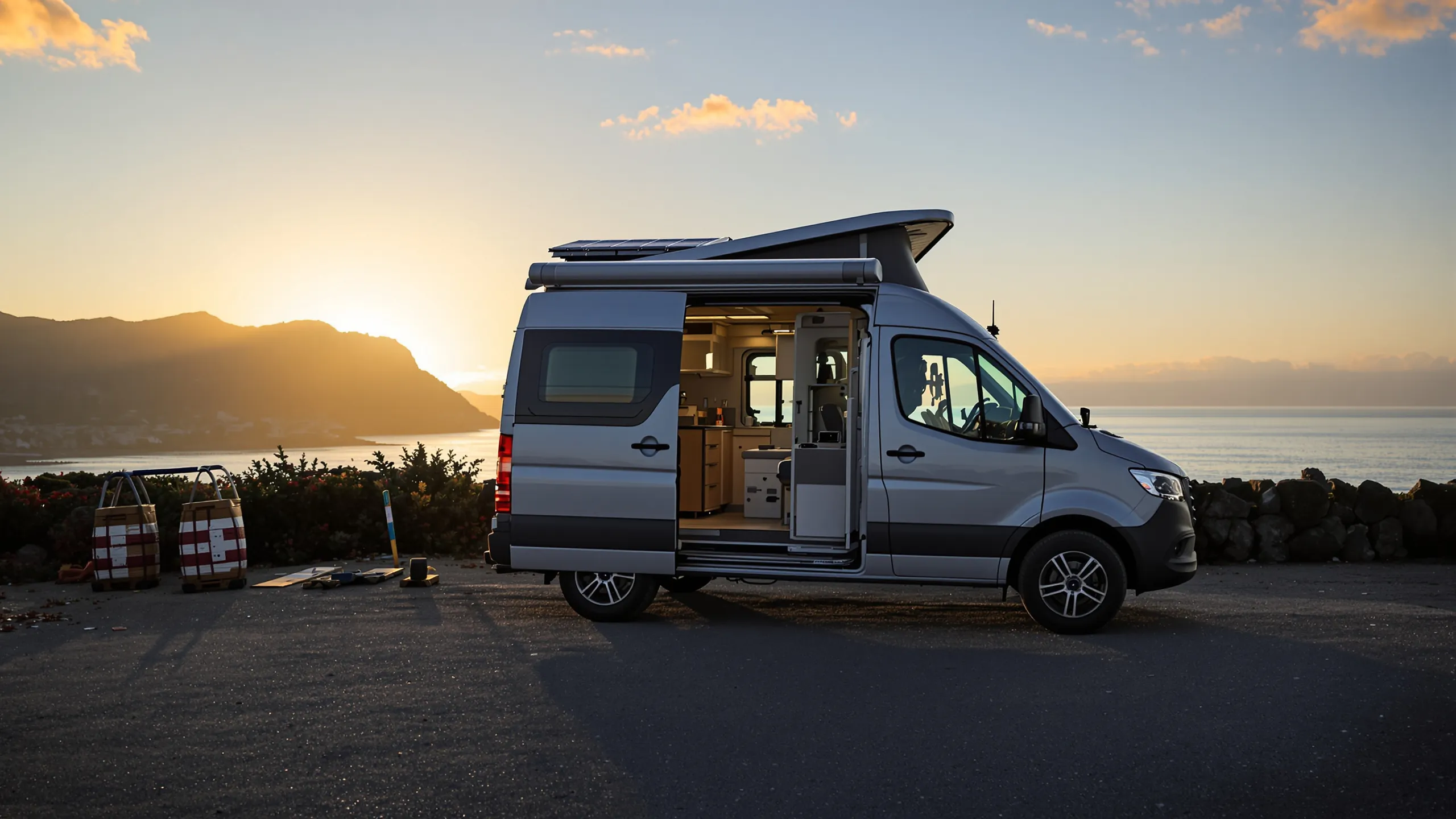
Van life remote work: what it takes to live the dream and work full time from a van
The feed sells the dream: the sliding door, the sea view and the laptop. But reality? A Tuesday at 2 pm with a client call at 3, a battery at 40% and two grey days behind you. Before you bet everything on that dream, this guide runs the numbers.
The real test of van life: eight hours of work, not eight hours of travel
Can you genuinely work a full day in this vehicle, five days a week, for months? Your freedom depends on getting three non-negotiables right.
A real workspace. Two hours at the van's kitchen table? Fine. Eight hours on a bench with no back support and the screen 30 cm below eye level? That’s not the freedom you imagined. Serious van workers build a proper desk: a swivel driver's seat or a fixed seat at the right height, a portable 15 or 16 inch second monitor, an external keyboard and a stand that brings the laptop to eye level.
Enough power and reliable internet, because your working day depends on both. Covered in the next two sections.
Power: size it for winter
Don’t let a dead battery steal your workday, and the freedom you came for. A laptop, monitor, router, lights, fridge and water pump realistically need 60-100 Ah a day, more with Starlink. Protect your peace of mind with proven setups:
- 300-600 W of solar on the roof
- 200-400 Ah of lithium storage (LiFePO4, not the old AGM batteries)
- a DC-DC charger that charges the battery while you drive
- an inverter for anything that needs 230 V
In a southern European summer, you’re practically self-sufficient. But a central European November changes everything: on dull days, that same system delivers only a fraction, and shore power at an aire or campsite becomes your lifeline. Size it for winter, not for August, and keep your freedom powered when it matters most.
Internet: Starlink plus a local SIM
Work somewhere extraordinary, without leaving your connection to chance. Starlink Roam has turned working in remote places from a gamble into an infrastructure question. In Europe, the Roam plan currently costs about €45 a month for 100 GB and about €95 for unlimited data. Starlink treats Europe as one region, so you can roam with no time limit, from Norway to Portugal. Outside your own region, roaming on the unlimited plan is now limited to about 30 days at a stretch. Heading to Morocco? Check the rules in your account first: Starlink has changed these terms several times. The hardware costs a few hundred euros, and the antenna is hungry for power.
Want lower costs and less power consumption? A 5G router with an EU SIM delivers both. But don’t let roaming limits derail your plans: EU tariffs have fair-use limits, not designed for permanent work abroad. Months away from the home network risk surcharges or termination. Outside the EU roaming rules, in Montenegro or Andorra, for example, the tariff does not apply.
Give your freedom a stronger foundation: a local data SIM or eSIM for everyday use, Starlink for places without a mast.
Overnight parking is not camping: protect your dream escape before stress takes over
Don’t let one simple mistake steal your freedom: sleeping in your vehicle to rest before driving on is not the same as camping. In Germany, for example, you may spend one night in the vehicle where it can legally park, roughly ten hours as a rule of thumb. But bring out chairs, awning and levelling blocks, and you are camping, which is not allowed outside designated sites.
Longing for Southern Europe? Protect that dream, because the rules have become much stricter:
- Portugal has banned wild camping in principle since 2021. Registered motorhomes get narrow exceptions of up to 48 hours outside protected areas, while coastal and nature zones are strictly patrolled. Keep your money for memories, not penalties: fines start at about €70 and reach several hundred euros in protected areas.
- Spain has no national rule, just a patchwork of regions and municipalities. Coastal hotspots get cleared and fined; inland is often relaxed. Don’t let that glorious sea-view stop become a painful expense: fines range from about €60 to €600 by region, and much more in nature reserves.
- Scandinavia is the friendly exception with its right of public access, but that freedom has limits you cannot afford to overlook. That right applies to tents. Vehicles stay on roads and parking areas.
Take the anxiety out of finding your next stop: pitch apps such as park4night show official aires, tolerated spots and reviews. Put your trust in recent comments, not old entries.
Tolls can take a painful bite out of your adventure budget too. France, Spain, Portugal and Italy charge by distance, often €50-100 each way on long transits. Austria (annual vignette €106.80 in 2026) and Switzerland (CHF 40) use vignettes for vehicles up to 3.5 t, with separate systems above that.
Without an EU passport, protect your plans: your European adventure is also limited by your visa-free allowance or your visa.
The residence trap: a van does not replace a home base
Imagine chasing freedom, only to drive straight into a painfully expensive mistake. You hear the promise everywhere: leave your home country, move into a van and leave tax behind. It is the rolling version of an old mistake. Deregistering in your home country does not by itself end your tax residence. Being resident nowhere does not make you tax-free, it leaves you exposed everywhere, as we explain in our guide What is a perpetual traveler? and living stateless as a digital nomad. Without a new residence, no tax treaty protects you. Your home country can still point to ties such as a room at your parents' or a vehicle registered there.
And that van you bought for freedom? It makes those ties impossible to ignore. Registration and insurance tie you to an address. A vehicle is registered to a keeper with an address in the country where it is based. Keep a van abroad for good on home plates, and eventually it is not correctly registered anywhere. Service providers or relatives may seem like the answer, but those workarounds come with catches, too. Policies are usually priced for a vehicle based in the country of registration, while add-ons such as breakdown cover are often limited to trips of a few weeks to a few months. No end date for your trip? Talk to your insurer before your peace of mind is on the line.
If you are a US citizen, moving away does not end your obligation: you remain subject to US income tax on your worldwide income wherever you live (IRS).
Do not let an avoidable mistake derail the freedom you are working towards: first a new tax base, then the lifestyle. Establish real residence with an address, a right of residence and a certificate of residence, then travel Europe by van from there. Take that first step: choose your base with our country comparison.
What your van life dream really costs
| Item | Typical range |
|---|---|
| Used, well-converted panel van | €30,000-60,000 |
| New van with off-grid package | €70,000-100,000 |
| Diesel (10-12 l per 100 km) | about €18-22 per 100 km |
| Fuel for 15,000 km a year | about €3,000 |
| Pitch per night | €0 (tolerated spot) to about €40 (with power, high season) |
Your van bleeds several thousand euros in value every year, before you’ve even paid for maintenance, tires and repairs. Then the bills pile up: tolls, ferries to Morocco or Scandinavia costing hundreds per crossing, insurance, gas and internet. You bought into the dream of freedom. But those bills? They follow you everywhere.
Be brutally honest with the numbers: van life rarely costs less than €1,500-2,500 a month, depreciation included. That is about the budget of an apartment nomad renting monthly in Lisbon, Tbilisi or Chiang Mai. The van only wins if waking up somewhere new every morning, without packing, feels so priceless that you’re genuinely happy to pay that price.
Chase the seasons. Feel the freedom.
Your route is your energy lifeline. Follow the rhythm long-term travelers trust: south in winter, to Andalusia, the Algarve or by ferry to Morocco, where sunshine keeps your solar yield, and your spirits, steady. North in summer, into Scandinavia's glorious long days or the Alps. Spring and autumn? Embrace the Atlantic coast, the Balkans and Greece.
Fight the seasons and you pay twice: full sites and bans on the Algarve in August, a flat battery and miserable condensation in central Europe in November.
The van life nobody posts, and whether it’s your kind of freedom
Freedom still comes with chores. Water, grey water, the toilet cassette, gas bottles and laundry together take several hours a week. That’s the everyday reality behind the dream.
Loneliness is real, but so is finding your people. Regular overwintering spots in southern Spain and Portugal, van meetups and online groups that turn into convoys can bring genuine community to life on the road.
Protect your peace of mind. Break-ins are a known problem in hotspots, especially on the southern French and southern Spanish coasts and at known motorway rest areas, sometimes while people sleep inside. Keep work gear out of sight, back up to the cloud, fit good locks and sleep at managed aires.
Van life can be your kind of freedom if your work is asynchronous, you have few fixed video calls, and you’re willing to understand your own electrics and water system. But don’t force the dream: it does not work with back-to-back calls, if cramped space wears you down, or if the van is really meant as a tax-saving scheme. You don’t have to choose all or nothing. The middle way many choose: a fixed tax base with an apartment, and the van for three to six months a year.
Frequently asked questions
Is Starlink enough to work from a van?
Your office, your view, your freedom, technically, usually yes. In Europe the Roam plan costs about €45 a month for 100 GB or about €95 for unlimited data, with no time limit inside the Europe region. Want extra peace of mind? A second line via a local SIM or eSIM is safer, because Starlink draws a lot of power and needs a clear view of the sky.
How much solar and battery do I need for full workdays?
Don’t let grey skies put your workday, and your peace of mind, at risk. Proven setups use 300-600 W of solar and 200-400 Ah of LiFePO4 storage, plus a DC-DC charger and occasional shore power. Build for grey days, not just summer sunshine, and work with confidence.
Can I wild camp in Spain and Portugal?
Less and less, and nothing spoils that feeling of freedom like a fine. Portugal has banned wild camping in principle since 2021, with narrow exceptions for registered motorhomes. Spain regulates it by region, with fines of up to several hundred euros. Protect your adventure: plan with official aires and current pitch apps.
Can I give up my home address and just live in a van?
Yes, but don’t mistake freedom for a tax-free life. Without a new tax residence elsewhere, you’re still exposed. Vehicle registration, insurance and banks still need an address. Protect your dream: set up your base first, then embrace van life.
Want a base that makes van life feel free?
The van is the easy part. Your base, with residence, address and tax position, is what keeps you out of trouble. Don’t let uncertainty steal the freedom you’re chasing. In a consultation, we work out what that base can look like for you.
Book a consultation