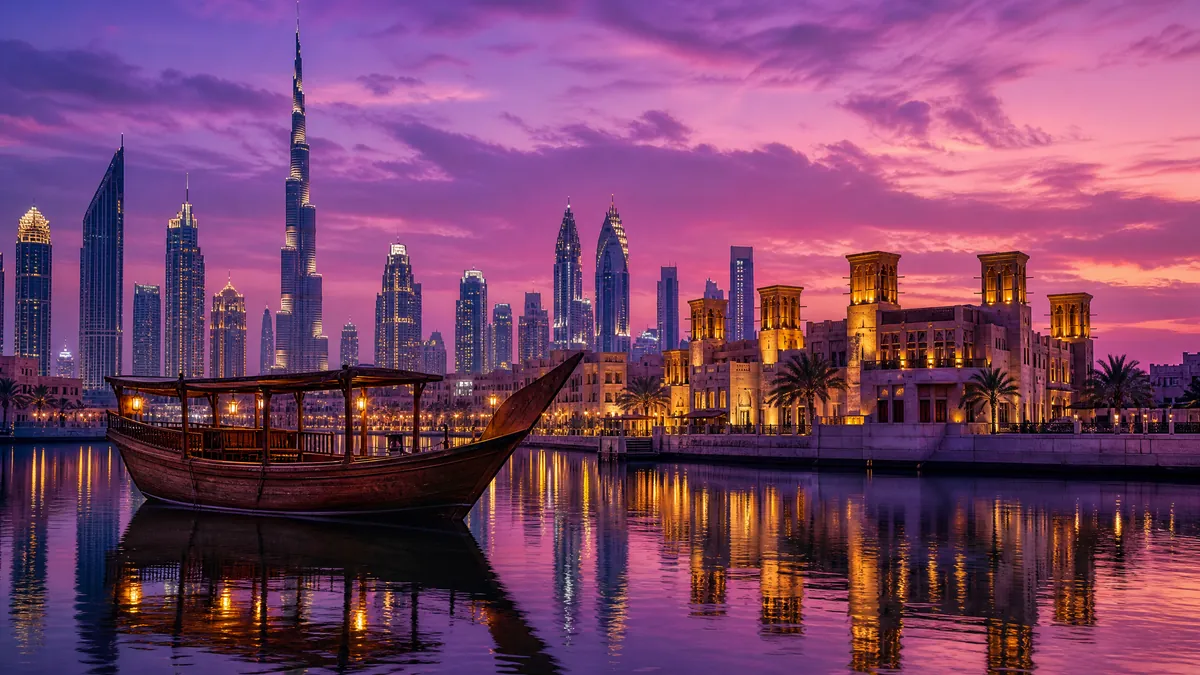
🇦🇪 Unlock Your Dream Life: Dubai Digital Nomad Visa and the Other UAE Routes
Imagine keeping more of what you earn. The Emirates launched one of the world's first remote work visas in 2020 and still make the clearest tax promise: 0% on personal income. Your route depends on whether you are employed, freelance or run a company.
At a glance
| Program | Virtual Working Programme (Dubai) / Remote Work Visa (federal) |
|---|---|
| Income threshold | US$3,500 a month from abroad (Dubai); 6 months of bank statements since 27 January 2026 |
| Duration | 1 year (Dubai), renewable; lapses after more than 6 months abroad in a row |
| Where to apply | Online with GDRFA Dubai, possible from abroad; processing usually within 48 hours |
| Fees | About AED 1,500-1,700 (about €380-430) incl. Emirates ID after the April 2026 cut; plus medical test and insurance |
| Family | Yes, family members can be sponsored with the Emirates ID |
| Tax | 0% personal income tax; tax residency certificate needs 183 (or 90) days of real presence |
| Permanent residence | No; longer routes via Green Visa (5 years, AED 360,000 a year) or Golden Visa (10 years) |
Is there a Dubai digital nomad visa?
Not under that name, but your Dubai dream has options. What everyone calls the nomad visa is Dubai’s Virtual Working Programme, and federally the Remote Work Visa. A freelance permit, the Green Visa and a free zone company offer three more routes, and for many self-employed people, they’re a better fit than the nomad visa itself. Ready to picture your life in the Emirates, and what it costs? Explore our UAE country profile.
| Route | Where to apply | Duration | Entry hurdle |
|---|---|---|---|
| Virtual Working Programme (Dubai) | Online with GDRFA Dubai, possible from abroad | 1 year, renewable | US$3,500 a month from abroad |
| Abu Dhabi remote work route | Online via TAMM or the ICP channels | 1-2 years by variant | Income proof as in Dubai |
| Freelance permit plus residence visa | Online with the free zone, visa on site | Permit yearly, visa usually 2 years | License from about AED 5,750-7,500 a year |
| Green Visa (self-employed) | Online with ICP or GDRFA | 5 years, self-sponsored | AED 360,000 a year, degree |
Your next chapter deserves more than guesswork: employees of a foreign employer take the Virtual Working Programme. Freelancers with several clients often thrive with a permit plus residence visa, and the freedom to serve clients in the UAE too. High-earning self-employed people seeking peace of mind look at the Green Visa, while entrepreneurs with their own company usually find their path forward with a free zone setup.
The Virtual Working Programme in Dubai
Your remote career. Your next chapter in Dubai. Launched in October 2020, Dubai’s program was the first in the Emirates. The authority is the General Directorate of Residency and Foreigners Affairs (GDRFA) Dubai; apply fully online via gdrfad.gov.ae. Best of all, you can apply from abroad before you enter. Here’s what you need in 2026:
- Monthly income of at least US$3,500 from remote work for employers or clients outside the UAE. Business owner? Since the programs merged at the end of 2022, the same threshold applies to you, plus proof that your company has existed for at least one year.
- Since 27 January 2026: bank statements for six consecutive months, up from three. Don’t let outdated advice derail your plans: guides that still say three months are out of date.
- An employment contract with an employer outside the UAE or proof of self-employment, plus a passport valid for six more months.
- Health insurance valid in the UAE for the whole term, because travel insurance is not enough. Find your starting point in our overview of health insurance for digital nomads.
Your Dubai plans deserve a realistic budget, not an outdated price tag. The often quoted fee of about US$600 dates from the program’s early years. After the fee cut of April 2026, government costs including the Emirates ID come to roughly AED 1,500-1,700, about €380-430. Add the medical test and insurance, often the largest single item. Rates vary by emirate and change without notice: check the current GDRFA fee table before you apply.
Ready to make it real? The process is simple: upload, pay, processing usually within 48 hours according to GDRFA, then entry, medical test, biometrics and Emirates ID. That ID lets you sign a lease, open a bank account and sponsor family members. This isn’t just a visit. You are a resident, not a visitor.
Protect your next chapter from two traps. The visa lapses if you spend more than six months in a row outside the UAE. And income from UAE companies is not allowed on this visa; serving local clients requires a freelance permit or your own license.
Abu Dhabi and the freelance permit
Imagine making Abu Dhabi your next chapter. Its own remote work track runs via the TAMM portal, handled through the federal authority ICP. Requirements largely mirror Dubai: income from a foreign source, six months of statements since January 2026, insurance, and a fully digital process with biometrics after arrival. Several sources consistently report a two-year Abu Dhabi variant in 2026 with an income threshold of US$4,000 a month. Before you fall in love with the possibility, protect your plans: Abu Dhabi publishes no stable official list of conditions. Treat the two years as a possibility, not a promise, and check on TAMM. The welcome bonus? Noticeably lower rents.
Dreaming of building something that’s truly yours? The second main route is a freelance license followed by a residence visa. This is full self-employment in the UAE: the freedom to invoice local clients, with renewal tied to your license rather than a foreign contract.
- GoFreelance (TECOM, Dubai) puts your media, tech and education ambitions within reach at AED 7,500 a year (gofreelance.ae). Add the establishment card (about AED 2,000) and residence visa (AED 4,600 for one year, AED 5,042 for two), and your first year comes to roughly AED 14,100-14,500, about €3,400-3,500.
- Talent Pass (Dubai Airport Free Zone) helps creatives, consultants and tech freelancers take that next step: AED 7,500 a year, about AED 13,600 in the first year with establishment card and two-year visa according to DAFZ.
- Free zones in the northern emirates (such as Sharjah, Ras Al Khaimah, Fujairah) start at about AED 5,750, your cheapest entry if the freedom you crave matters more than the Dubai label.
Give your next chapter more than hope: give it a clear-eyed budget. These prices are ballpark figures, not fixed rates: free zones change packages and visa quotas constantly, and in 2026 some Dubai clusters temporarily restricted visa issuance. Ready to build a business beyond your own labor? A free zone company with a residence visa is the standard route. Whether that or a lean US LLC fits better depends on your clients and home country.
Green Visa and Golden Visa
Ready to build a life, not just plan your next renewal? The Green Visa gives you five years of residence, self-sponsored, without an employer or yearly renewal. For the self-employed, ICP requires a freelance permit from the labor ministry MOHRE, a bachelor's degree or specialized diploma and annual income of AED 360,000 over the two prior years, or alternatively proof of financial solvency. That is about €90,000 a year. Dreaming further ahead? The Golden Visa offers ten years, with its own thresholds for investors and top talent, though rarely the first step for a nomad.
Taxes: zero, with footnotes
There is no income tax on individuals. Picture it: more of your hard-earned money stays yours. No withholding on wages, no capital gains tax, no tax return for your foreign salary. On the remote work visa, your income stays untaxed in the UAE. That’s more room to build the life you want.
The first footnote matters if you’re licensed and self-employed: since 2023 corporate tax of 9% applies to profits above AED 375,000. Under Cabinet Decision 49/2023, individuals only fall within it if their licensed business turnover exceeds AED 1 million a year. Here’s your breathing room: salaries, private investments and private real estate income do not count. VAT is 5%.
The second is residence, because your peace of mind deserves solid ground. Under Cabinet Decision 85/2022, you are tax resident with 183 days in twelve months, or with 90 days plus a residence or a job or business in the UAE. A tax residency certificate requires actually meeting these conditions and proving it with a lease, Emirates ID and entry and exit records. Your visa alone does not unlock it.
The third is your home country. Protect your fresh start from the tax bill you never saw coming. Your home country's rules decide whether you remain taxable there. A tax treaty with the UAE matters: without one, there is no tie-breaker if both countries claim you. If you are a US citizen, you remain subject to US income tax on your worldwide income wherever you live (IRS). Don’t leave your next chapter to chance: explore the Dubai UAE tax guide on sebsauerborn.com.
The cost reality
Don’t let the visa price fool you: it’s the cheapest part of the project. As a single person in Dubai you will spend €3,000-5,000 a month for a comfortable everyday life. Rents are traditionally paid a year in advance: that means having a year's budget in cash when you move in. Want more breathing room? Abu Dhabi, Sharjah or Ras Al Khaimah cost noticeably less.
The US$3,500 threshold is formally enough to apply, but tight for life in Dubai. Below a monthly income of about €6,000, rent and running costs often swallow more than the 0% income tax saves. Don’t let the zero-tax dream squeeze your budget. For a zero-tax setup at lower cost, explore Georgia, and find your fit by comparing other programs in our overview of all digital nomad visas.
Frequently asked questions
Does Dubai have a digital nomad visa?
Yes, your Dubai dream could become reality with the Virtual Working Programme, run by GDRFA Dubai since October 2020. Enjoy one year of residence, renewable, while working remotely, if you earn at least US$3,500 a month from abroad.
Can I bring my family on the UAE remote work visa?
Yes! Once you hold the Emirates ID, you can sponsor family members, because your next chapter should include the people you love.
Do digital nomads pay tax in Dubai?
Keep more of what you earn: the UAE has no personal income tax. Corporate tax of 9% only affects individuals with licensed business turnover above AED 1 million. But don’t overlook this: your home country may still tax you.
How much does the Dubai digital nomad visa cost?
Your Dubai dream just got closer. After the April 2026 fee cut, roughly AED 1,500-1,700 (about €380-430) including the Emirates ID, plus the medical test and health insurance.
Which UAE route is right for you?
Your next chapter deserves the right start. We help you find out whether the remote work visa, a freelance permit, the Green Visa or a company fits your work, and understand your home country's rules before you move.
Book a consultation