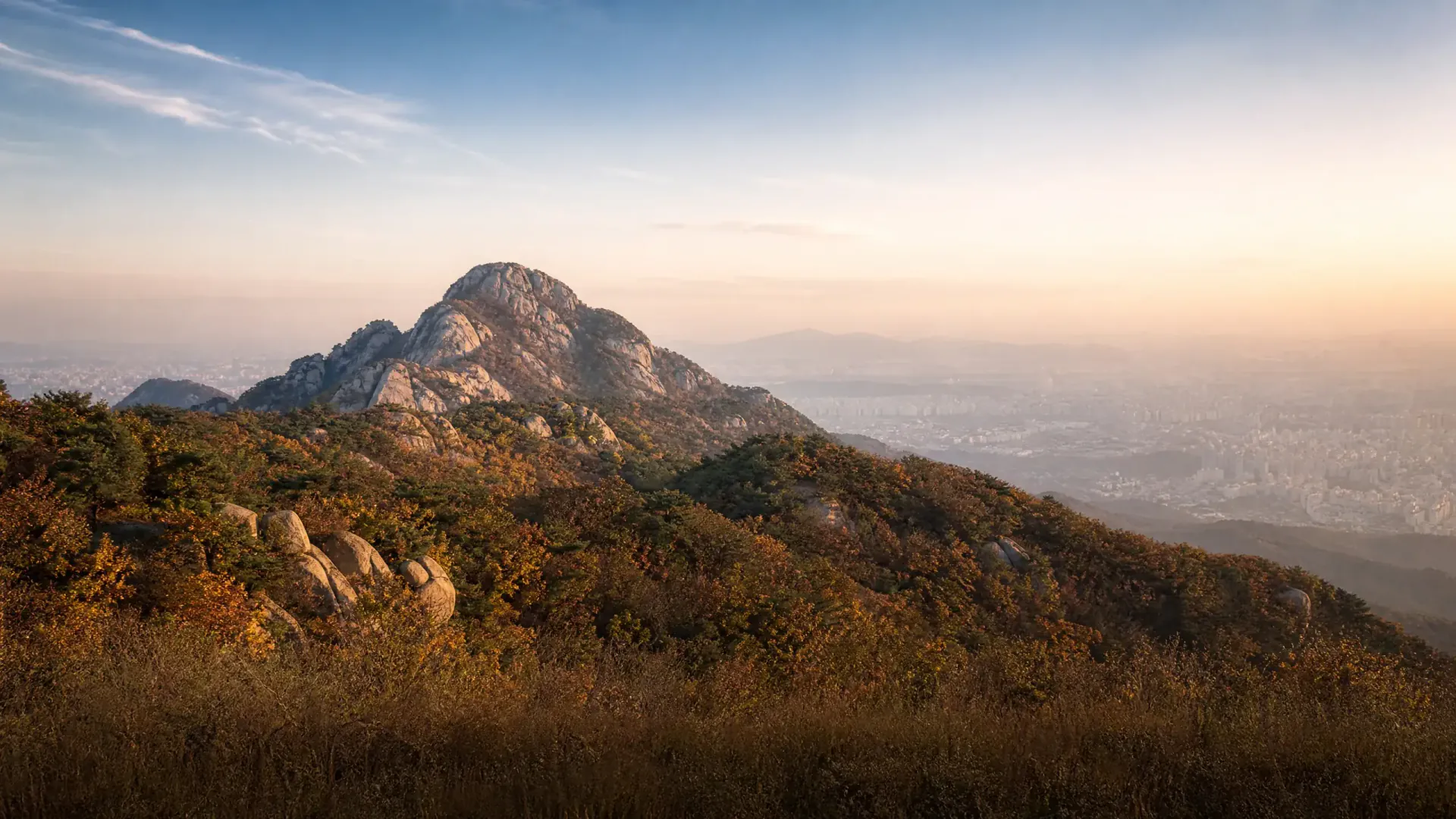
🇰🇷 Digital Nomad Korea: Fast, Safe, and Thrillingly Far Ahead of Europe
Imagine your workday in South Korea: the fastest networks, superb public transport, very high safety, and a food and café culture you’ll love, with a new workation visa to make it possible. The trade-offs? High prices in Seoul, a real language barrier and a time zone far ahead of Europe.
At a glance
| Monthly costs | Seoul €1,700-2,600; Busan or Jeju €1,200-1,900 |
|---|---|
| Internet | Fiber 500 Mbps-1 Gbps for KRW 30,000-45,000 a month |
| Time zone | UTC+9 |
| Best season | April-June and September-November |
| Long-stay route | F-1-D workation visa: up to 3 years, renewed annually |
| Income threshold (F-1-D) | 1x-2x Korean GNI per capita; 1x only for ages 18-34 living outside Seoul, Incheon and Gyeonggi |
| Tax on foreign income | None under 183 days; residents under 5 of the last 10 years taxed on foreign income only when remitted |
Why South Korea draws digital nomads
That South Korea dream? It just moved within reach. On 30 June 2026 the Ministry of Justice officially launched the F-1-D workation visa after two and a half years as a pilot, with better terms worth getting excited about: lower income thresholds for younger applicants who live outside the Seoul metropolitan area, and stays of up to three years. The change was announced on 7 July 2026.
Picture your everyday life in the most technically advanced country on our list: the fastest networks, superb public transport, safety on a par with Japan, and a food and café culture that makes exploring feel irresistible.
But follow your heart with your eyes open: a time zone far ahead of Europe, a language barrier higher than in Japan, and an intense work culture around you that rubs off.
Everyday life
Feel life move faster, and discover how freeing that can be. In Korea, deliveries arrive the same day, often within hours. The subway runs every two minutes, with mobile reception even in the tunnels. Pay contactless everywhere and handle government services digitally. Less friction. More freedom. More room to live.
And when inspiration strikes at 2 am? Life is still awake. You can still find a café with a power socket, ready for that idea you just can’t let go.
But that exhilarating pace has a demanding side. Korea has one of the world’s most intense work and education cultures. Even as an outsider, you’ll feel that pressure shaping the life unfolding around you.
Want to stop feeling like a visitor and truly settle in? One practical detail can make all the difference: a residence card (ARC). Without it, many everyday services are hard to access. Bank accounts, mobile contracts and many apps and online services require a Korean ID number. That’s a powerful reason to choose a formal residence permit over a tourist stay.
Where to live: find the place that feels like you
Seoul is the obvious choice, and it could be the love of your life: a metropolitan region of more than 20 million people. Lose your heart to Seochon and Bukchon, the quiet, charming, old, small-scale neighborhoods around the palaces. Feel your creativity come alive in young, café-filled Yeonnam-dong and Mangwon. Embrace international life in Itaewon and Hannam. Feed your ambition with the business, money and high-rise energy of Gangnam. Craving a deep breath? Mountains run through the city, with a hiking trail just twenty minutes away by subway.
Busan on the south coast is the second city, and your chance to finally exhale. Warmer and more relaxed, with beaches inside the city at Haeundae and Gwangalli, it gives you much of Seoul's infrastructure at much lower rents. Less pressure on your budget. More space to enjoy your life.
Jeju is the volcanic island in the south: green, mild and so spectacular it might just change what you want from life. It’s the favorite retreat of Koreans themselves, with a small, growing remote-work scene and a government that actively promotes workation stays there. Why just dream about this backdrop when it could be your everyday?
Gangneung on the east coast puts beach, mountains and coffee culture at the heart of your everyday life, with Seoul still under two hours away by KTX train. Your escape, without feeling out of reach.
Internet and work
Stop letting slow internet hold you back. Korea leads the world here, with fiber delivering 500 Mbps to 1 Gbps for KRW 30,000-45,000 a month. Enjoy nationwide, extremely fast mobile coverage, with 5G as standard.
Find your remote-work sweet spot in Korea’s café culture. Spacious cafés have a socket at every seat, and settling in for hours is completely normal. Want your own space to focus? Study cafés, paid workrooms with individual desks, are excellent and very cheap. For a fixed desk, coworking in Seoul offers a wide choice at KRW 250,000-500,000 a month.
Visiting short-term? Without a Korean ID number, you cannot get a fixed-line contract, but you can stay connected with prepaid data and your accommodation's Wi-Fi, which is good throughout Korea.
Food
Korean food is one of the most distinctive cuisines on our list, and every meal is a chance to fall in love. Think rich fermentation, an abundance of side dishes that come free with every meal, and an irresistible balance of spicy, sour and umami. Even better? It is unusually rich in vegetables.
Big flavour, without a big splurge: prices range from cheap to moderate. A good lunch costs KRW 8,000-15,000 and usually includes side dishes, soup and rice.
Two realities to know before you go: vegetarian or vegan eating is hard, because fish sauce and meat broth go into many dishes, and alcohol plays a very large role in social life.
People and language
Here’s the biggest trade-off, and it’s tougher than in Japan. Koreans are helpful, generous and genuinely warm once you connect. That warmth is worth discovering, but building those connections takes longer than in Taiwan or the Philippines.
Don’t let education levels fool you: English is spoken much less than you might expect. In Seoul’s international neighborhoods, you can get by; beyond them, things quickly get challenging. Korean grammar takes effort, but here’s your first win: the logical Hangul alphabet is readable within a few days. Learning it makes daily life much easier, and is strongly recommended.
Want to feel truly connected? Korea’s social circles grow through school, university, work and military service, making them hard for outsiders to enter. Without Korean, that friendly bubble remains your limit.
Seoul has a large international community, but expect mostly employees, teachers and students, rather than the self-employed.
Cost of living
Don’t let living costs catch you off guard: Korea is more expensive than most people expect, and Seoul is one of the pricier cities in Asia.
| Item (KRW a month) | Seoul | Busan / Jeju |
|---|---|---|
| Furnished studio (officetel), good location | 900,000-1,600,000 | 600,000-1,000,000 |
| One-bedroom apartment | 1,400,000-2,500,000 | 900,000-1,500,000 |
| Groceries and eating out | 700,000-1,200,000 | 600,000-1,000,000 |
| Coworking, fixed desk | 250,000-500,000 | 180,000-350,000 |
| Fiber internet | 30,000-45,000 | 30,000-45,000 |
| Public transport | 60,000-100,000 | 50,000-90,000 |
| Private health insurance | 100,000-250,000 | 100,000-250,000 |
Picture your new life in Korea, then budget for the reality: €1,700-2,600 a month in Seoul and €1,200-1,900 in Busan or on Jeju.
Don’t let the housing hurdles derail your dream. Korea's jeonse system, a very large refundable deposit instead of monthly rent, is usually not an option for newcomers. Your normal route is an officetel or a furnished monthly rental, usually still requiring a deposit of several months' rent. And that ARC? It makes opening a bank account easy; without one, it’s difficult.
Health and safety
Breathe easier knowing Korea's excellent healthcare system is there when you need it: modern, very fast, with short waits and low prices by international standards. It is an established medical tourism destination, especially for dermatology, dentistry and cosmetic surgery. On the F-1-D you rely on private cover, and the visa requires a policy with at least KRW 100 million of coverage for treatment and repatriation. Protect your next chapter with essential peace of mind; see health insurance for digital nomads.
Feel the freedom of living somewhere exceptionally safe, comparable to Japan and Taiwan. Violent crime and theft are rare, and being out at night is no problem. Enjoy that precious sense of ease.
But give your dream move the clear-eyed care it deserves. Air quality suffers from fine dust, especially in spring, a real consideration if your airways are sensitive. And the security situation on the Korean peninsula remains a constant concern. It plays no role in daily life, but deserves careful thought before you make a very long-term commitment.
Climate
- Spring (April to June) and autumn (September to November) are a delight: mild, clear and dry. For sheer beauty, nothing beats autumn, the most beautiful time of year.
- Summer (July and August) brings the heat: hot and humid, with a rainy season in July and temperatures above 30 °C.
- Winter (December to February) is cold and dry, regularly well below freezing in Seoul, with clear skies and little snow. But indoors, welcoming underfloor heating in apartments makes winter more comfortable than in Japan or Taiwan.
Prefer milder weather? Choose Busan or Jeju; Jeju is the mildest.
Getting there and the time zone
Your Korean adventure is closer than it feels. Flights from Europe to Seoul take about 12-14 hours, because routes avoid closed Russian airspace, with many connections via Istanbul, Dubai and Doha. Once you arrive, the KTX train whisks you from Seoul to Busan in about two and a half hours, and very cheap flights to Jeju put that island escape within reach.
But protect the freedom you came for: Korea is on UTC+9, the same difficult setup as Japan. With clients in Central Europe (UTC+1, UTC+2 in summer), you are seven to eight hours ahead: their 9 am start means 4 pm for you, pushing your whole overlap into your evening and night. Make this dream work with asynchronous work or a narrow evening call window; otherwise, the time difference simply does not work.
Entry and the F-1-D workation visa
Stop just dreaming about Korea. Start picturing your life there. Whether you can enter visa-free, for how long, and whether you need the K-ETA electronic travel authorization depends on your passport. Some passports are exempt from the K-ETA until 31 December 2026, with reintroduction planned from 2027. Your adventure matters: check before every trip.
Why settle for a fleeting visit when you could stay longer? The F-1-D, officially the workation visa, opens that door. It ran as a pilot from January 2024 and became permanent on 30 June 2026. Here’s what could shape your next chapter:
- Duration: don’t just visit, feel at home for up to three years, renewed annually (the pilot allowed two at most).
- Income: the life you’ve imagined could be closer than ever, with tiered thresholds replacing one figure. The old rule was twice Korea's gross national income (GNI) per capita, most recently about KRW 105 million or about US$74,000. Now the threshold ranges from one to two times GNI per capita, depending on age and region. The lowest, about half the old figure, applies only if you are 18-34 and live outside the Seoul metropolitan area (Seoul, Incheon and Gyeonggi). The intermediate tiers are not spelled out, so give your dream a solid foundation: if you do not meet both conditions, plan on twice GNI per capita until it is clarified.
- Profile: take your career into your next chapter: you must be at least 18 years old, with at least one year of experience in the same field, working for a company outside Korea or running your own foreign business. Work for Korean companies or clients is expressly prohibited.
- Documents: turn excitement into preparation: health insurance with at least KRW 100 million of coverage, a criminal record certificate with apostille, and solid proof of income.
- Family: make memories together; spouses and minor children can come along.
- Switching: already in Korea visa-free? Keep your adventure going: you can switch without leaving.
The regional tiering steers remote workers toward less developed regions. Can you already picture your life in Busan, Gangneung or on Jeju? If you meet the relevant conditions, your income hurdle drops considerably, and that long-imagined life starts feeling within reach.
Don’t leave your next chapter to guesswork. Because the rules are new, procedures are still settling: check the current figures with the Korean embassy or consulate that covers your country before applying. Take your next step with the full breakdown in this South Korea F-1-D brief on our sister site.
Taxes in South Korea
Don’t let the headline tax rate crush your plans. South Korea taxes residents on their worldwide income at progressive rates that reach well over 40% at the top, plus local surcharges. You are resident if you have a domicile in Korea or spend 183 days or more there in a tax year.
But here’s the relief that could change everything for newcomers. Foreigners who have been resident in Korea for less than five of the last ten years are, in principle, taxed on foreign income only to the extent that it is remitted to or paid in Korea. Those first years can feel far friendlier than the top rate suggests.
In practice: stay under 183 days, and you owe no Korean tax on foreign income. Staying longer? Take control: manage the five-in-ten-years rule and your remittances carefully, bring as little foreign income into Korea as possible and pay expenses with foreign cards. Your planning matters.
And don’t overlook another valuable option: certain foreign employees can choose a flat rate instead of the progressive scale. Whether you qualify depends on how your work is set up. Before you make your move, check whether a tax treaty exists between Korea and your home country.
Your tax situation at home
Dreaming of Korea? For most people, it will be a stop along the way, not a new tax residence. Don’t let a fresh start catch you off guard: moving abroad does not automatically end your tax residence at home. Your home country's rules decide.
US citizens remain subject to US income tax on their worldwide income wherever they live; don’t let that become an unwelcome surprise (IRS).
Ready to make Korea your real new residence? The F-1-D gives you a solid permit, and the five-year rule offers several years of relief on foreign income. That’s a workable setup, but it’s limited to five years. Protect your plans: map out your exit or next step from the start. Our guide on where digital nomads pay taxes helps you understand how home and host country rules interact.
Is South Korea right for you?
Imagine living in the best-equipped country on our list, where safety, speed and infrastructure let you focus on what matters. If your work runs asynchronously, Korea could be your perfect fit. In 2026, the opportunity is especially exciting if you are under 35 or happy to live outside Seoul: the new tiered thresholds halve the income hurdle for exactly that group.
But don’t ignore what you need to feel at home. If you must be reachable every European morning, hope to build social roots without the language, or have a tight budget, think carefully: Seoul is expensive.
Want the same standard with a little more accessibility? Explore Taiwan. Crave precision and order above everything? Discover Japan. Need English as an everyday language to feel at ease? Look at Malaysia. Find the place that feels right for you: our overview of digital nomads in Asia compares the region.
Frequently asked questions
Do digital nomads pay tax in South Korea?
Your freedom matters, and so does your hard-earned money. Stay under 183 days? No tax on foreign income. Residents are taxed on worldwide income, but foreigners resident for less than five of the last ten years are in principle taxed on foreign income only when it is remitted to or paid in Korea.
Do digital nomads need a work visa in Korea?
Dreaming of calling Korea home? For long stays, the F-1-D workation visa allows up to three years of remote work for a company outside Korea or your own foreign business. Work for Korean companies or clients is prohibited.
How much does it cost to live in Seoul or Busan?
Make your dream life a reality: realistically, budget €1,700-2,600 a month in Seoul and €1,200-1,900 in Busan or on Jeju. Plan ahead: furnished rentals usually need a deposit of several months' rent.
Can I work with European clients from Korea?
Yes, but you’ll have to work for it. Korea is on UTC+9, seven to eight hours ahead of Central Europe, so your overlap lands in your evening and night. Want to make it work? Embrace asynchronous work or carve out a narrow evening call window.
Can I get by in Korea without speaking Korean?
In Seoul’s international neighborhoods, yes, but beyond them, everyday life can quickly feel overwhelming. The good news? Learning to read Hangul takes only a few days, and makes daily life so much easier.
Considering Korea?
Is Korea just a stopover, or your next home?
Your next chapter deserves clarity. We explore whether a visitor stay or the F-1-D fits your plans, how the remittance rule affects your foreign income, and what Korea means for your tax residence at home.
Book a consultation